History
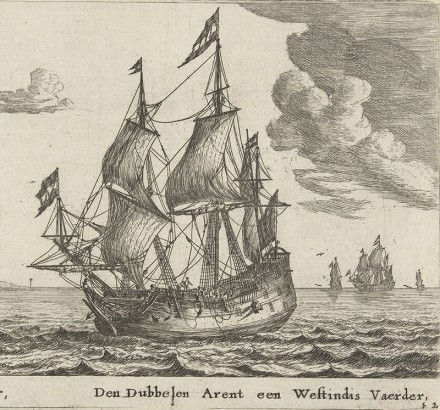
The Neptunus was a yacht of the Dutch West India Company (WIC), equipped for transporting enslaved people. Together with the Gekroonde Bril it had left the slave depot of Gorée (in Senegal) on January 6th, 1664. The Gekroonde Bril had 337 enslaved people on board. We do not know the numbers for the Neptunus.
Attack by Holmes
The two ships had hardly left when they were attacked by the Jersey and the Catharina under captain Robert Holmes. After a short exchange of shots, the Gekroonde Bril surrendered. The Neptunus was also taken. The British were able to get close because they were flying the Dutch flag and thus were impersonating Dutch ships. Furthermore, it was peace between the English crown and the Dutch Republic:
"...that the English, under the command of Captain Robert Holmes, being near Kabo Verde, took a certain ship, called the Bril, and the yacht Neptunus, belonging to the Dutch West Indian Company, in the month of January past: that the English ship, which took the Neptunus, was carrying a flag of the States in top." (See Brandt, p. 290.)
This was the start of the second Guinean expedition of Robert Holmes. He managed to conquer most of the WIC fortresses in Western Africa.
Declaration from the Amsterdam City Archives
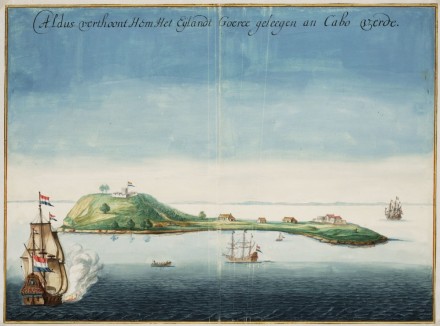
In an attestation in the Amsterdam City Archives, the attack on fort Nassau is described. Robert Holmes arrived at the roadstead of Gorée (the island was named after Goeree in Zeeland, the Netherlands) with two mentioned British ships, and two conquered Dutch ships, the Gekroonde Bril and the Neptunus.
In the afternoon of January 31st 1664, Holmes demanded the surrender of the WIC fortress Nassau. That was refused. Then an bombardment with the cannons began, that lasted until sunset. Under cover of darkness, the English sailed with small ships towards two ships that were anchored at the roadstead, the Visser of the WIC and the Viskorf, a privately owned vessel. They were both taken. They were heavily fired upon in the dark from the fortress. Because of this, the Viskorf was shot on fire and sank. The next day, the garrison surrendered. The walls had collapsed during the last rain season and they were out of gunpowder.
Luck
Holmes was surprised by this windfall. His ship was also badly damaged and the chances of him taking the fortress by force were small. The Dutch lost five ships in the action of Holmes:
The Gekroonde Bril, Neptunus, Visser, and the Viskorf. At the surrender they also had to give up the yacht the Krokodil. Two months later, the Gouden Leeuw was also sunk.
The Viskorf sank on the roads and the Visser would later be lost. The rest went over into English service. The sources do not report what finally became of the Neptunus.
Description
Status
The ship was not lost.
References
- Brandt, Geeraardt
Het leven en het bedrijf van den Heere Michiel de Ruyter. - Atlas of Mutual Heritage
Fort Nassau - Amsterdams notarieel archief, Notaris Cornelis de Grijp > 1665 Januari 1-1665 Juni 30
ref. no. 2583 (scan 195)