History
Slave ship licensed by the WIC
The Gekroonde Bril was a (private) slave ship that operated under license of the Dutch West India Company (WIC). It left on January 6th, 1664 together with the Neptunus from the slave depot fort Nassau on the island of Gorée (in Senegal) with 337 enslaved people on board.
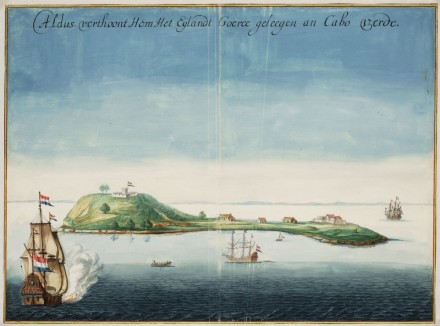
The two ships had hardly left when they were attacked by the Jersey and the Catharina under captain Robert Holmes. After a short exchange of shots, the Gekroonde Bril surrendered. The yacht Neptunus was also taken. The British were able to get close because they were flying the Dutch flag and thus were impersonating Dutch ships. Furthermore, it was peace between the English crown and the Dutch Republic:
"That the English, under the command of Captain Robert Holmes, being near Kabo Verde, took a certain ship, called the Bril, and the yacht Neptunus, belonging to the Dutch West Indian Company, in the month of January past: that the English ship, which took the Neptunus, was carrying a flag of the States in top."
English attack on the WIC in Afrika
In October 1663, Holmes had received the command over a small flotilla and was sent to the African coast, under specific orders of king Charles II to "...protect and further the interests of the Royal [African] Company, which is the only goal of your present voyage..." and "...to kill everyone that opposes you, or to imprison, sink or destroy them."*
Holmes went about this with much fervor. After taking the Bril, he attacked the slave fortress Nassau. The WIC fortress surrendered after six hours of battle:
"Robert Holmes, the thirty-first of that month [Januari], having taken the stronghold of Kabo Verde, on the island Goederede, and after that having fired upon, and forced to surrender, the yacht the Krokodil: that the night before that he had taken two more vessels, the Vischkorf and the Visscher." (Brand, Book 6, p. 290).
In the action of Holmes, the Dutch lost five ships: the Gekroonde Bril, Neptunus, Visser, and the Viskorf. upon the surrender the yacht Krokodil also had to be given over. Two months later, the Gouden Leeuw was also sunk.
The Viskorf sank on the roads and the Visser was to be lost later. The rest passed into English service. What happened to the Krokodil in the end is not clear from the sources. In the end, the Gekroonde Bril sailed to Cayenne under British command where the enslaved people were sold. Of the 337 people on board, 253 survived the voyage.
Reaction of the Republic
Michiel de Ruyter was secretly sent to Western Africa in 1664 to dam the English aggression towards the WIC. He was to reconquer the WIC forts on the African coast. De Ruyter managed to retake most of the fortresses, amongst which the one on the island Gorée.
After his succesful actions on the African coast, De Ruyter crossed the Atlantic to attack the English in America and the Caribbean (see the expedition of the Ruyter on the Atlas of Mutual Heritage.
*) King Charles II Stuart had founded the Royal African Company (RAC) in 1661. His rule was aimed at British expansion at the cost of the Dutch Republic. The actions of Holmes in Africa were one of the causes of the outbreak of the Second Anglo-Dutch War in 1664.
Description
The ship was not lost.
| Master | Victol, Cornelis Cornelisz. |
|---|
Status
It is not clear what became of the ship.
References
- slavevoyages.org
ID 11590 - Brandt, Geeraardt
Het leven en het bedrijf van den Heere Michiel de Ruyter 6, 290 - pepysdiary.com
The second African expedition - Aitzema, L.
Saken Van Staat En Oorlog V 110 - Amsterdams notarieel archief, Notaris Cornelis de Grijp > 1665 Januari 1-1665 Juni 30
ref. no. 2583 (scan 195) - Canon van Nederland
vensterplaat slavernij - Atlas of Mutual Heritage
Fort Nassau - Atlas of Mutal Heritage
Michiel de Ruyter's expedition to West Africa and the Americas.