History
The Gier was a warship that was built in Rotterdam by the just newly appointed master shipwright Glavimans.
In 1799, the brigantine the Gier was stationed outside the estuary between the islands of Vlieland and Terschelling under luitenant captain Nicolai Connio, together with the frigate Draak under captain van Esch.
After the Vlieter Incident of August 30th 1799*, both ships were stationed behind the Wadden Islands between Makkum and Harlingen. On September 13th, 1799, two English frigates (the Arrow and the Woolverine) flying the 'prince's flag' (the colors of the Dutch Prince of Orange in exile) were sighted. Without any attempt at defence, the Gier surrendered. Shortly after this, after a short fight, the Draak was also taken.
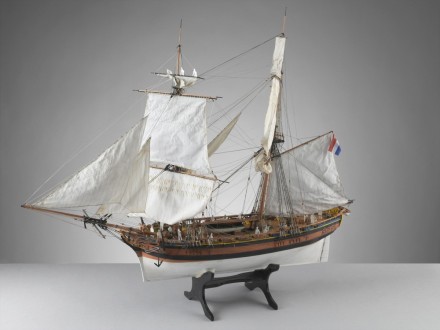
Connio and van Esch had to answer before the high naval court martial. Van Esch was demoted. The punishment for Connio was much heavier. Connio had been appointed captain in the Maze Admiralty in 1784 (see references).
He was sentenced to death because of dereliction of duty and cowardly behaviour. De Jonge offers as mitigating circumstances that the crew of the Gier tended towards mutiny and doing nothing because many of them supported the Oranjes (De Jonge, p. 500).
The Gier went over into British service and was demolished in Sheerness in 1803 (see Threedecks.org under references).
Batavian navy
It was the time of the patriots. The Oranje family had fled the Netherlands and the Batavian Republic had been proclaimed. At the founding of the Batavian Republic in 1795, the naval forces, consisting of five Admiralty colleges, were combined and renamed 'The committee for the affairs of the Navy'. The navy would henceforth be governed centrally, also after the Batavian period.**
*)The Vlieter Incident was an event on 30-08-1799 in which a complete Batavian fleet squadron surrendered without resistance to the English in the Vlieter estuary.
**)Many crewmen on the ships, especially in the lower ranks, were adverse to the new Batavian Republic. They had been influenced by the driven out supporters of the Oranje family. Even though the new regime improved the circumstances for the 'common man', so also for the crews on board.
Description
References
- De Jonge, J.C.
Geschiedenis van Het Nederlandsche Zeewezen, V, 496
pp 496 e.v. - RCE
Schepen op de Admiraliteitswerf gebouwd. - HTRHub
Archief van de Admiralteitscolleges. - Threedecks.org
Threedecks.org