History
WIC ship near a Dutch island
The Witte Haas was a ship of the Dutch West India Company (WIC). On September 27th, 1674, the ship was lost at half a mile north of the Dutch coastal island of Schiermonnikoog. According to a source it was on the reef "Paardemarkt by bad visibility and negligence of the pilot". The ship had departed on May 4th from Elmina (on the Gold Coast of Africa, now Ghana), together with the Eendracht.
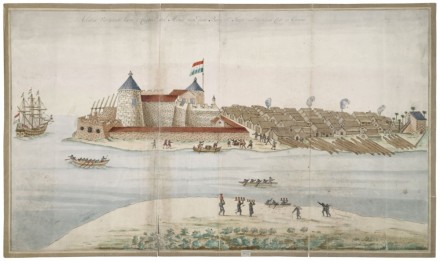
The Witte Haas had a difficult journey. On September 5th, the ship was between the Azores and Ireland. At the height of the Shetland islands, the skipper Jan Muyssen Huyg died (because of the Anglo-Dutch War they were forced to take the longer, but less dangerous route 'around the back'*).
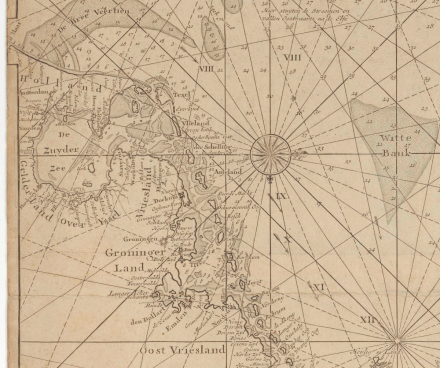
The outgoing director general of the Gold Coast, Dirck Wilree (1635-1674) was also on board. On that fateful day, when the ship got stuck on the reef, he drowned with a part of the crew and the ship was smashed to pieces by the waves (see Binder, p. 20 under references).
Fishermen from the island salvaged part of the goods on board. The WIC received the goods back in exchange for a salvage fee.
36 years after the accident with the Witte Haas, on June 3rd 1710, a wooden box filled with gold was found on the beach of Schiermonnikoog. The people who found the box, brought it to Henrica Helmhout, the regent of Schiermonnikoog. This news on the valuable find did not go unnoticed. In the end, there were three parties that laid claim to the ownership of the box of gold. The first party that entered a plea for restitution with the Court of Friesland was Maria Wilree, the daughter of Dirck Wilree. In the end, the ownership of the box was awarded to the WIC (see de Jong under references).
* The 'route around the back' avoided the English Channel and went past the west coast of Ireland and North of Scotland to the North Sea. This was thought safer in times of war.
Description
| Master | Jan Muyssen Huygh |
|---|
Status
According to Slavevoyages.org, a WIC ship called the Haas transported enslaved people in 1669. It is not clear if this concerns the Witte Haas. The voyage went from New Calabar in Nigeria to Suriname and of the 429 people transported on board, 300 survived the voyage. The captain then was Theunis Post.
References
- Hylkje de Jong (2021)
Het quaestieuse verdronkene goud
Amsterdam University Press - NL-HaNA_1.05.01.02_2_0011
- Binder, F., Norbert Schneeloc
Dirck Dircksz.Wilre en Willem Godschalk van Focquenbroch
Bulletin rijksmuseum 29,1
pp 13-29 - slavevoyages.org
Slavevoyages