History
Batavian Republic
After the proclamation of the Batavian Republic in the Netherlands, the Dutch admiralty colleges were reformed and joined into a single navy. In this eventful time of the Napoleonic wars, there was much resistance within the navy because many officers and crew members were supporters of the house of Orange so they supported the exiled stadtholder. The Vlieter Incident is one of the most important examples of this.
Surrender by the Batavian squadron
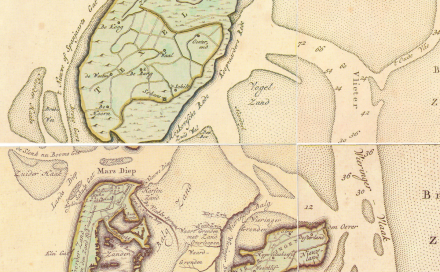
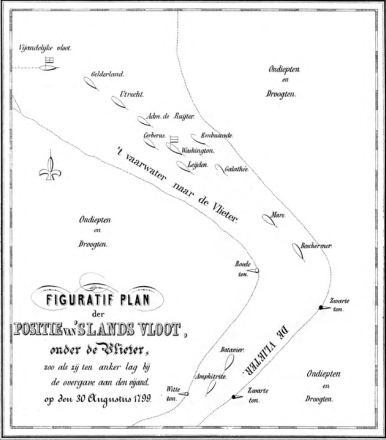
In the early morning of August 30th, 1799, a Batavian squadron lay at anchor near de Vlieter behind the island of Texel*. The Anglo-Russian invasion of North Holland was in full swing. The Batavian Republic and its ally France were under heavy pressure. The Batavian fleet squadron had temporarily retreated on August 28th to the Vlieter "a more inward lying and narrow fareway" (De Jonge V, p. 461).
When the British fleet under vice admiral Andrew Mitchell appeared and demanded their surrender, the Dutch rear admiral Samuel Story gathered his officers to discuss the military options. Some captains indicated that they did not want to fight, others remained silent. The tensions were palpable in the fleet, in which a significant part of the officers and crew members were sympathetic towards the house of Orange.
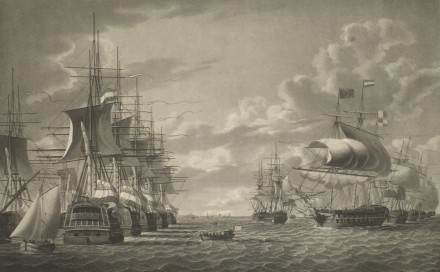
The situation looked bleak. By the unfavorable position of the ships, the open defiance of the officers and the increasing revolt among the crews, he concluded that resistance was futile. Story decided to surrender the fleet without a fight.
Formally and legally seen, Samuel Story surrendered to the British. But politically and symbolically, there was a very significant element that showed the sympathies for the prince of Orange, because Mitchell demanded that the Batavian ships should transition to using the so-called 'prince's flag' (the flag of the exiled stadtholder William V).
Background: the invasion of 1799
The Vlieter Incident took place in a turbulent time. After the flight of stadtholder prince William V to Britain, the patriots proclaimed the Batavian Republic. French revolutionary troops aided the Batavian patriots in this. The atmosphere was one of upheaval and renewal. The old regime was replaced by a parliamentary democracy. At the onset, this received widespread support. Yet along the way, discontent arose because the economic situation worsened and the pressure by their older brother France turned increasingly repressive. Added to this was that the discontent was eagerly fueled by supporters of the house of Orange from abroad. The support for them grew, especially under the poorer segments of the population.
in 1799, a large military offensive was started as part of the war against Napoleon. A combined English-Russian operation commenced on August 27th. The British fleet landed ca. 12.000-13.000 troops in North Holland. The invasion went smoothly at first: the port city of Den Helder soon fell into allied hands.
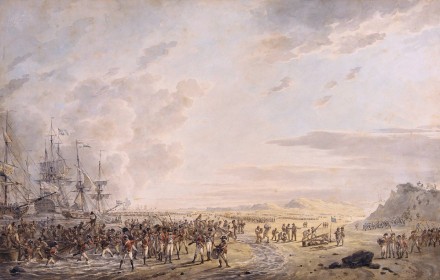
Shortly after this, the English fleet sailed up the Marsdiep and enclosed the Batavian navy. It seemed to go well for the invaders on all fronts.
Outcome
Yet the offensive quickly came to a standstill. French and Batavian troops managed to regroup. The supporters of the house of Orange had misjudged the situation. They were definitely not welcomed with open arms everywhere. After a few chaotic battles, amongst which those at Bergen (September 19th) and Castricum (October 6th), it turned out that the allied army was not able to penetrate towards Amsterdam and the rest of the country. With exhaustion, logistic issues and the approaching winter taken into account, a peace was signed. In the Convention of Alkmaar, a truce was concluded that allowed the allied forces to depart safely in return for ending the fight. The Batavian Republic continued to exist.
*) The Vlieter is a fareway and area with shallow water near the island of Texel. It was the connection between the North Sea with the deeper waters of the Marsdiep and the Zuiderzee. This general area was the most important roadstead of the Netherlands in the past.
References
- De Jonge, J.C. (1862)
Geschiedenis van Het Nederlandsche Zeewezen, deel V
pp 238 - Wikipedia
Vlieter-incident