History
The San Pedro was a Dutch-built sailing ship, part of a Spanish fleet that was en route from Havana, Cuba to Spain. Captain-General Rodrigo de Torres left Havana Harbor with his fleet to return to Spain on Friday, July 13, 1733. On the voyage, the fleet encountered a hurricane as they were passing through the Florida Keys. Their attempts to turn back to Havana were futile, and most of the fleet was scattered and sunk across 80 miles of Florida coast in one of history’s most devastating maritime disasters.
The 287-ton Dutch-built vessel San Pedro carried 16,000 pesos in Mexican silver and numerous crates of Chinese porcelain.
Located and looted
Since the early 1960s, divers have located most of the wrecks associated with the 1733 fleet. However, the archaeological integrity of many of these shipwrecks have been damaged by repeated attempts at treasure hunting and looting.
The wreck of San Pedro was found in the 1960s near Low Matecumbe Key. In the subsequent years, the site was heavily salvaged by treasure hunters before it was protected by state and federal laws. Silver coins dating between 1731 and 1733 were recovered from the pile of ballast along with numerous anchors and cannons. Elements of the ship's rigging and hardware, as well as remnants of its cargo, were also unearthed and removed.
Description
Status
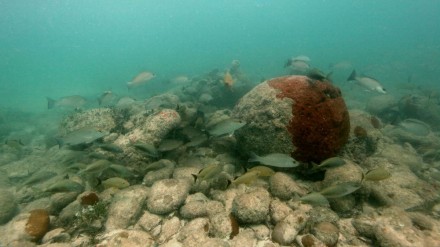
The wreck of the San Pedro was found in 5.5 metres of water, some 2.32 km off Indian Key, Florida. The site is marked by a large pile of ballast which used to be stored in the lower holds of the ship for the sake of stability.
All perishable materials that remained above the sand were gone when underwater archaeologists visited the site, though underneath the sand, parts of the wreck remain. It was noted that the site had been heavily looted by treasure hunters in the past. Silver coins found between the rubble dated from 1731 to 1733 support the date of shipwreck. Even red ladrillo bricks from the galley were found among the ballast.
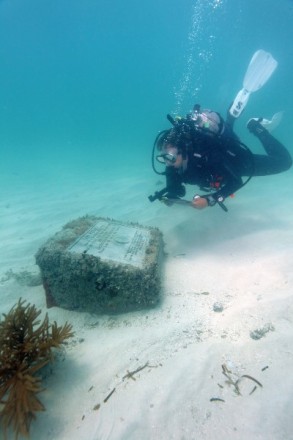
The underwater memorial plaquette
Archaeological monument
The large pile of ballast, dense stones from European river beds, typically stacked in lower holds of sailing ships to increase their stability, marks the spot where the San Pedro went down. Mixed in with the ballast are flat, red ladrillo bricks from the ship's galley.
In 1989, this site became a State of Florida Underwater Archaeological Preserve. Replica cannons, an anchor from another 1733 shipwreck site, and a bronze plaque were placed on the site to enhance its interpretation. As part of a shipwreck trail, divers can freely enter the site and personally experience this underwater cultural heritage site.
References
- NOAA
San pedro - Center for Underwater Science, Indiana University
1733 San Felipe and San Pedro Shipwrecks - flheritage
San Francisco