History
1975 : discovery of the Pommeroeul site and excavations by the SNF
During earthworks on the Hensies-Pommeroeul canal in Pommeroeul, Belgium, in the summer of 1975, archaeological objects were unearthed at a depth of 2.5 metres. Léonce Demarez, an amateur archaeologist, was the first on the scene, followed by Guy de Boe and François Hubert, archaeologists from the Service National des Fouilles (SNF, the national archaeological service).
The remains revealed a site occupied from the Neolithic period to the Roman era. The most important occupation is revealed in the form of a Gallo-Roman port town located at the junction of the Bavay-Blicquy road and the river Haine. This location gave it a predominant role in the commerce and industry commercial for the Nervii people.
The Pommeroeul site is known for its outstanding archaeological material, including a large number of shoes and, above all, Gallo-Roman boats, including a barge and the dugout canoe.
Description
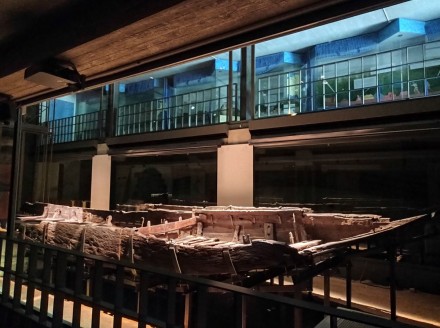
The barge (dating from the turn of the 1st and 2nd centuries CE) is a flat-bottomed boat that sailed on rivers and streams. It is preserved at a length of 12.70 meters and was originally between 18 and 20 meters long.
Considered the ancestor of today's barge, the boat was used to transport heavy goods in Roman times. It is a remarkable testament to inland waterway transport, trade and the economy of the Belgian countryside at the beginning of the last millennium. It is housed in the Espace Gallo-Romain museum and has been listed as one of the top archeological treasures of the Wallonia-Brussels Federation since 12 February 2010.
| Length | 41 ¾ feet (12.7 m) |
|---|---|
| Width | 9 ½ feet (2.9 m) |
References
- Espace gallo-romain of Ath (museum)
The Pommeroeul's boats