History
The 'Oranjeboom' remained in Asia after her first voyage (January 17, 1640). She served on the Far East route (including China, Cambodia, Japan, and Taiwan).
In 1643, during a stay in Cambodia, the ship was confiscated by the Khmer and placed in the Royal Navy along with the yacht Rijswijk. Two years later, they were returned to the VOC.
VOC in Cambodia
The Khmer Empire was a supplier of, among other things, deerskin, ray skins, and gum lacquer. These products were highly sought after in Japan. This trade was in the hands of the Portuguese for a long time. The VOC first appeared on the scene in 1620. It received permission—naturally much against the wishes of the Portuguese—to establish a trading post in the city of Laweck (near Phnom Penh). That was not a great success.
After two years, the post closed. In 1635, another attempt was made a little further on, near the capital Udong. That attempt did not go smoothly either. In 1637, the ship 'Noordwijk' ran aground on the Cambodian coast. The cargo and 13 cannons were seized. This caused resentment in Batavia.
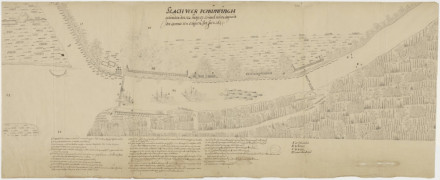
VOC embassy killed
It was a very turbulent period in the Khmer Empire. When the old King Chea II died in 1631, his young son Ponhea Nou ascended the throne. Ponhea Nou (1631-1640) was ruler in name, but the empire was governed by his uncle, Regent Outey. When Ponhea Nou died in 1640, Outey placed his own son, Batom Reachea, on the throne. In doing so, he bypassed the rightful heir to the throne, Ponhea Chan. In 1643, Ponhea Chan managed to kill his nephew and uncle in a palace revolution (September 1643). It was at precisely that moment that a VOC delegation led by Pieter Van Regemortes arrived in Udong. He possessed far-reaching powers to reclaim the 'stolen' VOC assets or, at the very least, substantial compensation. To reinforce his demands, he arrived in the capital with three heavily armed ships—the yacht 'Rijswijk' and the flutes 'Oranjeboom' and 'Noordster'.
The brand-new king was ordered to comply with the demands, or else force would be used. This did not sit well with the young king. He reacted very differently than Regemortes had expected. The Dutch delegation was killed (November 27, 1643). At the same time, the VOC trading post was plundered, resulting in the deaths of another 36 VOC officials. 50 survivors were imprisoned. These were the majority of crew members from the Dutch ships that had come ashore. The 'Rijswijk' and the 'Oranjeboom' were consequently so understaffed that they were easily captured. The 'Noordster', which lay further downstream, managed to escape and sailed back to Batavia at full speed. To restore the honor and influence of the VOC in Cambodia, the Council of the Indies decided to send a (punitive) expedition for real (March 1644).
A squadron of five ships armed to the teeth (the yachts 'Leeuwerik', 'Dolfijn', and 'Kievit', the flute 'Noordster', and the frigate 'Wakende Boei') was sent to Cambodia under the command of Admiral Hendrik Harouze to settle matters in the VOC's favor.
The 'Noordster' remained behind at the "Muskietengat" in the eastern course of the Mekong to stand guard. The rest sailed up the Mekong River. They reached Udong (June 3, 1644). Meanwhile, the Khmer were well prepared.
The four VOC ships walked into a trap. Two pontoon bridges were laid behind the ships as barriers to cut off the retreat. Subsequently, the VOC ships were attacked from the bank by dozens of galleys. Harouse succeeded in disabling the largest battery on the bank. The first pontoon bridge could be sailed through. The second obstacle was reinforced with an iron chain. With an amphibious landing, the chain was destroyed, and the ships were freed from their precarious position. Thus, all ships managed to escape by evening. The commander and 60 men had been killed.
The retreat proceeded via a more westerly arm of the Mekong, as a result of which the 'Noordster', which was located in another branch, was unaware and therefore lagged behind. On June 22, 1644, the 'Noordster' was attacked by Khmer ships, including the 'Rijswijk' and 'Oranjeboom', which had been seized earlier. These were manned by sailors who had been captured previously. The attack was repelled. They even managed to recapture the Oranjeboom. However, it ran aground shortly afterwards and had to be abandoned. On June 27, the Noordster reached the open sea. The punitive expedition had failed completely, and the trading post was abandoned. The VOC was forced back to the negotiating table.
It was not until two years later, in 1646, that a treaty was concluded with King Ponhea Chan stipulating that the Dutch captured in 1643, the confiscated goods, and the 'Oranjeboom' would be transferred to the Dutch East India Company.
The Oranjeboom returned to Batavia on April 24, 1647. The ship had been completely stripped of all cannons and armament. There were still 29 captured VOC members on boar
Description
References
- DAS 0538.1
- VOC in oorlog met Cambodja
- Muller, Hendrik Pieter Nicolaas (1917)
De Oost Indische compagnie in Cambodja en Laos. Verzameling van bescheiden van 1636 tot 1670
Van Linschoten-Vereeniging - NA 1.04.02 , inv. 1163 sacan 77-78