History
Privateer fleets
In 1628, several privateer fleets were deployed by the Dutch West India Company WIC). At the end of January, the first fleet of twelve ships left under Simon van Uitgeest with Brazil as its destination. A second fleet of twelve ships led by Admiral Pieter Adriaanszoon Ita left for the Caribbean. It was Ita's assignment to capture ships from the Spanish silver fleet. The third fleet was to depart later that year and was commanded by Piet Hein.
The Leeuwin was part of the second fleet. Ita's flotilla also consisted of the Walcheren (admiral), Dolfijn van Amsterdam (vice admiral), Eendracht van Dort (rear admiral), Goede Fortuin (chamber Zeeland), Vriese Jager (yacht), Kat and the Noordster.
Ita captures two Spanish galleons
On August 1, two large galleons, the St. Jago and the Nosa Senhora de Remedios, rounded cape San Anton (the westernmost point of Cuba), and were spotted by Dutch scouts. The next morning the Spaniards tried to enter Havana under full sails, yet the bay was blocked by Ita. The galleons had to sail past Havana and were driven toward the coast By the Dutch where they ran aground just east of Havana.
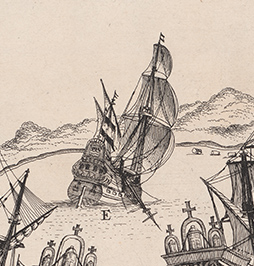
The Dutch tried to get closer with the intention to board. During this attempt the Leeuwin also stranded. The ship was heavily bombarded by the Spaniards. The rest of the Dutch ships were warned and kept their distance. The fight lasted all day. Eventually the Dutch overpowered both galleons. The Spanish crew gave up the fight, jumped overboard and reached the coast swimming.
According to de Laet (see references), the losses on the Spanish side were large; more than half of the 300 crewmembers aboard the vice-admiral ship were said to have died opposed to about twelve dead on the Dutch side. The Spanish admiral ship could be towed away by Ita, but the St. Jago was stuck and had to be left behind. The Leeuwin was probably towed away and repaired later.
There is a ship's list of 1639 of ships that were in Recife. The Leeuwin also appears on that list, manned with 48 heads and 18 cannon, with the remark that it had still had supplies for three months (see references).

Description
Yard: Middelburg
WIC chamber: Zeeland
Tonnage: 200 tons/100 last
Crew: 79
Armament: 2 bronze, 12 cast iron cannon
There are some discrepancies in the sources concerning armament and tonnage. It is possible that, asides from the one that served under Ita, another ship called Leeuwin later sailed for the chamber Zeeland.
| Master | Pietersz, Jan |
|---|
Status
Possible slave trade
A WIC ship called Leeuwinne made several voyages with enslaved people according to Slavevoyages.org. It is possible that it concerns the same ship, though the number of people taken on board is very high for a ship of 100 last.
Voyages:
1638 From the Gold Coast, the Bight of Benin and the Bight of Biafra to Pernambuco. Of the 199 people taken on board, 177 survived the voyage.
1641 from Ardra to Pernambuco. Of the 316 people taken on board, 265 survived the voyage.
1642 from Africa to Pernambuco. Of the 297 people taken on board, 214 survived the voyage.
1643 from Ardra to Pernambuco under captain Pieter Lucifer. Of the 146 people taken on board, 133 survived the voyage.
1644 From the Gold Coast, the Bight of Benin and the Bight of Biafra to Pernambuco. Of the 333 people taken on board, 227 survived the voyage.
1645 from Ardra to Pernambuco. Of the 341 people taken on board, 278 survived the voyage.
References
- Laet, de (1644)
Historie ofte Iaerlijck verhael..., deel III
pp 35, 91, 176, 446 - Nationaal Archief, Den Haag, OWIC
ref. no. 1.05.01.01/57, pp 185 - slavevoyages.org
Slave Voyages