History
The Drenthe was a newly built ship of the line of 64 cannon. It left for the Mediterranean on December 13, 1783 in the squadron of vice admiral Pieter van Reynst. The squadron arrived at the Malaga roads on January 11th, 1784, where they stayed for ten days.
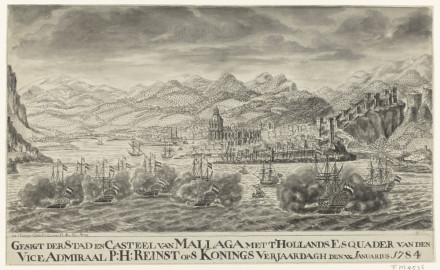
Heavy Storm
The squadron sailed further into the Gulf of Narbonne, destined for Toulon, when a heavy storm unexpectedly broke out during the night between 2 and 3 February.
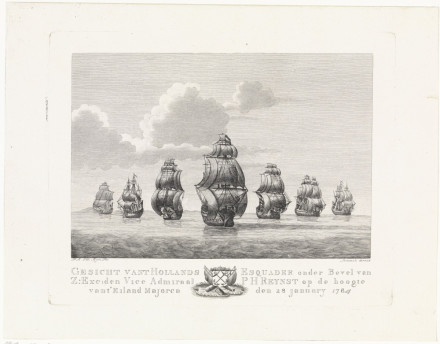
Damage
All ships, except the frigate Medea, were seriously damaged. The flagship Vrijheid was stranded, fortunately temporarily, on the coast of Minorca. The Admiral de Ruyter lost its top rigging. The ship Prins Willem threatened to be shattered several times on the rocks of the island of Minorca. The Noord-Holland lost its masts. The battered ship wandered around directionless for days.
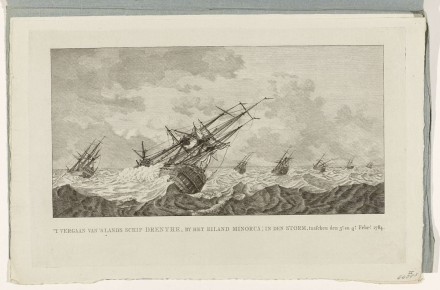
The Drenthe was lost on the rocks. De Jonge writes about this (see Zeewezen V., p. 71):
The ship Drenthe on the other hand was struck by an enormous disaster. This 64-gunner, after having wrestled through the first night of the storm, capseized at 8 'o clock in the morning of February 3rd, and sunk into the depths with all the 450 souls it contained, without the Noord-Holland and Medea, in whose proximity this terrible event took place, being able to offer any kind of assistance or to save one single man.
In the same book, de Jonge gives as an important cause of the loss of the ships of the line the Unie, Drenthe and Holland the inferior building quality, the green wood and the haste with which they were built (see de Jonge V, p. 5).
Description
Built: private yard in Amsterdam
Armament: 64 - 66 cannon
| Master | Smissaert, B.G. |
|---|---|
| People on board | 450 |
| Length | 167 ½ Amsterdam feet (47.4 m) |
References
- De Jonge, J.C. (1861)
Geschiedenis van Het Nederlandsche Zeewezen, V
pp 71 - Delpher, Amsterdamse Courant
ref. no. 04-03-1784 - Delpher, Amsterdamse Courant
ref. no. 06-03-1784 - Nationaal Archief, Den Haag, Admiraliteitsarchief
ref. no. 1.01.46, nr. 1498, pp 16 maart e.v.