History
A rich wreck whose identity only became known after years.
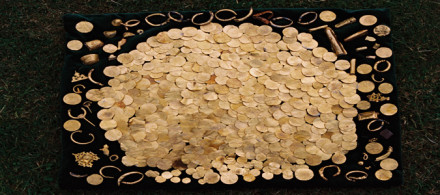
In the early 1990's, near Salcombe a wreck was found by the licensees of the Erme Estuary and Erme Ingot sites. They had noted the presence of cannon in gullies cut into the seabed at Garra Rock, Devon. In 1994 the South West Marine Archaeology Group (SWMAG) team dived on the cannon site and unexpectedly found an amount of exposed golden jewels and coins. The finds were handed over to the British Museum. Because of the presence of the cannon and the unknown identity of the wreck, it was called the Salcombe cannon wreck, and that is what it was called for decades.
Wreck site
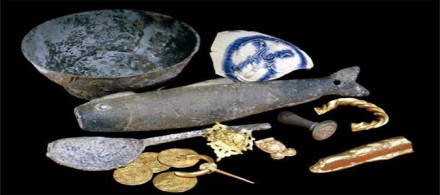
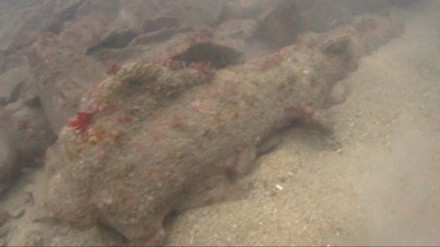
Only one hull fragment of the 17th century ship has been discovered to date, although there are sandy pockets in the gullies where more fragments may remain undiscovered. The majority of the remains of the wreck is formed by cast iron cannon and swivel guns, the cargo and anchors lying at a depth of around three meters. Ceramics found at the site were of Dutch, Portuguese and German origin, dating from 1580 to 1650. Some other finds include a Dutch pewter bowl and spoons from the same period.
Cargo and inventory
The cargo that was found is of Northern African origin. It is assumed that the majority of the cargo was salvaged shortly after the loss, but over 400 gold coins remained on the seabed until they were found by the SWMAG in 1995.
The cargo says very little about the origin of a ship. Yet items that can be identified as belonging to the ship's inventory do, such as personal belongings of the crew.
Pottery found in the wreck is of Dutch, Portuguese and German origin. There also are a Dutch pewter dish, spoons and a clay pipe. These point towards an origin in the Northern Netherlands (Amsterdam).
Arabian coins
The most striking feature of the wreck is the assemblage of Islamic gold coins and jewellery that was present there, the largest ever found in the United Kingdom. Upon discovery most if not all of these have been recovered due to the risk of visits by treasure hunters and for research purposes.
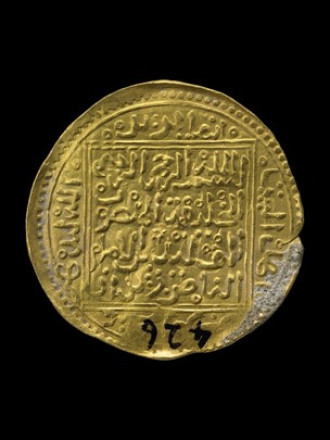
Analysis of the coins by Venetia Porter of the British Museum has indicated a Moroccan origin, with Marrakesh as the dominant mint mainly dating to the rulers Ahmad al-Mansur (1578-1603) and his son Zaydan (1608-1627). The two youngest coins, which provide a terminus post quem for the site, are from the reign of Muhammad al-Walid (1631-1636).
Jewellery.
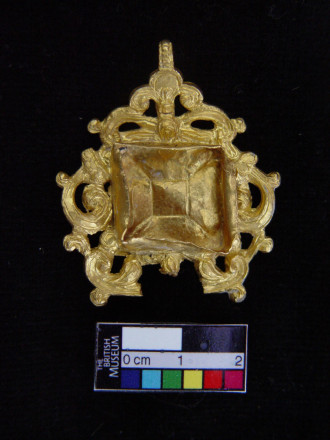
The jewellery, probably of Moroccan origin as well, included gold earrings and pendants and gold finger ingots. Much of the gold had been deliberately cut into pieces, suggesting that it was being traded as a bullion hoard. The collection currently resides at the British Museum.
Description
| Master | Dirck Pietersz. van Middelie |
|---|---|
| Tonnage | 240 ton (120 last) |
Status
The site was designated by English Heritage as an archaeological monument in 1997 and the artefacts were handed over to the British Museum for investigation. The less vulnerable cannon and anchors remain on the seabed, where the site is monitored on a regular basis.
Even though some things were known about the origin and the voyage of the ship on account o the cargo and inventory, its identity has long been a mystery. Yet this changed in 2016 because of research of employees of the British Museum.
Historian Ian Friel discovered documents on the voyage in the British National Archives, and found out the ship was a Dutch ship named the Dom van Keulen. The ship was leaking due to bad weather and sank near Salcombe. The crew managed to escape and a large part of the cargo was probably salvaged shortly after the loss. That cargo, amongst other things, consisted of over 9000 Moroccon gold coins, 150 bags of gum arabic, 64 bags of saltpeter and 320 goat skins.
The British Museum published a book on the wreck and the new research (see references).
Another wreck
Remains have been found at the same site that are thought to point to the presence of a Bronze Age shipwreck here, which is called the Moor Sand site.
References
- Finds from the Salcombe Cannon Wreck at the British Museum
- Porter, Venetia Parham, David (eds.) (2026)
From Morroco to the coast of England
British Museum - Bronze Age Artefacts – Salcombe-B Site
- Salcombe Cannon Site
- Popular Science
400 gold coins help crack a centuries-old shipwreck mystery.