History
Wreck from the Bronze Age
The Moor Sand location off coast of Salcombe is the site of a Bronze Age shipwreck off the coast of Salcombe in south-west England that was explored between 1977 and 2013. Nearly 400 objects including copper and tin ingots, bronze artefacts, fragments and gold ornaments were found. The Salcombe tin ingots provided a wonderful opportunity for the technical study of prehistoric tin, which has been scarce.
This site consists of a scattering of eight Middle Bronze Age (1800-1100BCE) tools, discovered between 1977 and 1982. The assemblage indicates that a prehistoric boat may have sunk at this point about 3,000 years ago, although the assemblage may have been eroded from adjacent cliffs (but this is considered to be less likely).
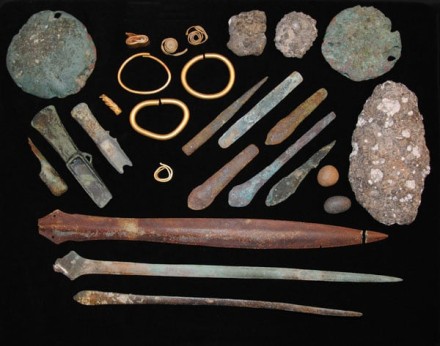
The assemblage of Middle Bronze Age weapons like swords and palstaves is thought to represent part of a contemporary cargo and thereby indicative of a shipwreck.
Dating
The swords, palstaves, and other bronze artefacts date to around the twelfth century BCE and are thought to have been manufactured in France. If this is the case, then France may have been the de facto departure point of the wrecked vessel.
Description
The Moor sand site is located close to the 17th-century wreck that became known as the Salcombe cannon wreck. This wreck was identified in 2026 as the Dutch ship the Dom van Keulen.
Status
Research
Despite metal-detector searches failing to find further artefacts in 1979, a short season of work was undertaken in 1982 by archaeologists from the National Maritime Museum. Using techniques developed on the designated Bronze Age wreck site at Langdon Bay, Dover, an area of the seabed was systematically searched in an attempt to assess the potential for work. No finds were made within the searched area but, while trying to locate datum points from earlier work, a bronze sword handle was discovered exposed on top of sand in a gully 20 metres to the southwest. Preliminary identification places the sword in the flange hilted family and its finding brings the total of bronzes artefacts from the site to eight. The fact that it was discovered in an area carefully searched in previous years suggests mobility of either sands and gravels, or artefacts, or both.
Protected status
The Moor Sand site is located close to the 17th-century wreck that became known as the Salcombe cannon wreck. This wreck was identified in 2026 as the Dutch ship the Dom van Keulen. Because the wreck is closely intertwined with this 17th century wreck, the area has been designated as protected under the Protection of Wrecks Act.
Conservation
All recovered objects are in the care of the British Museum and the site is closely monitored by Historic England (see references).
References
- historic england.org
Moor Sand