History
The Diemen was a yacht of the Dutch West India Company (WIC) Amsterdam chamber. It was a small yacht of 60 lasts, originally with 6 iron and 4 stone guns.
WIC Privateer Fleets
In January 1628, the WIC sent two privateer fleets to the West Indies. The first squadron was sent to the Caribbean and Cuba, under the command of Admiral Pieter Adriaanszoon Ita. He was very successful and captured a (small) part of the Silver Fleet near Havana. However, this success was completely overshadowed by the capture of the rest of the Silver Fleet by Piet Hein a month later.
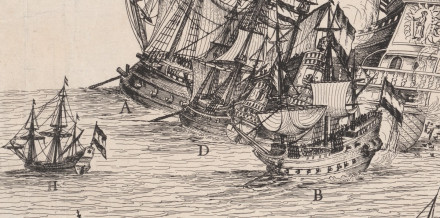
At the letter H, an example of a small yacht (De Noordster) comparable to De Diemen. The difference in size between ship (A) Walcheren, (B) yacht Dolfijn, and (H) Noordster is clearly visible. On a pamphlet by Pieter Adriaanszoon Ita near Havanna in August 1629.
The second squadron consisted of 12 ships under Admiral Simon van Uitgeest. Its destination was Brazil. He was ordered to attack the Spanish-Portuguese enemy there, capture as many ships as possible, and in the meantime explore the country and possibilities for settlement.
The Diemen was added to Simon van Uitgeest's fleet. It had 30 sailors and 48 soldiers on board. The two expeditions, and later a third in 1629 under Piet Hein, returned to the Netherlands extremely successfully. The Diemen was subsequently deployed regularly in the West Indies.
Ten years after
Ten years later, in 1639, De Diemen appears on a list of ships in Brazil. The list inventories the state's ships in the roadstead of Recife. It details how many men are on board, how much artillery, and, above all, how long they remain operational. This list reveals that De Diemen has only 2 pieces of artillery left on board and is manned by 12 men. After ten years of action, the ship is no longer operational as a war yacht. It is this yacht, virtually written off, that plays an important role in a story about corruption at the highest level in Brazil.
Johannes Maurits the Brazilian
This took place during the time of Governor Johan Maurits van Nassau-Siegen (1636-1644). Since his appointment in 1636, he was known as a skilled and driven administrator, humanist, and promoter of art and culture. He was given the nickname "The Brazilian." As the highest WIC official in the West Indies, he guarded the company's trade monopoly in the Atlantic region, which included Brazil and the west coast of Africa. Enslaved people were primarily brought in from that region, a trade that had grown into a major source of profit for the WIC and its officials. Johan Maurits legally purchased dozens of enslaved people at the market in Recife, but did not always adhere to the rules. During a punitive expedition into Portuguese territory around Bahia de Salvador, he purchased captured Portuguese enslaved people without the knowledge of the WIC. Bookkeeper Elias Herckmans noticed this and reported it immediately to the WIC directors, the Gentlemen XIX, in the Netherlands. (OWIC, 1.05.01.01 inv. no. 55)
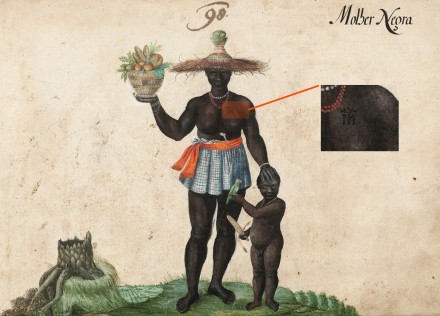
A shocking example of personal property is the famous image of Mother Negro by Zacharias Wagener. The owner's brand is visible on her chest. The monogram JM. Johannes Maurits
Illegal trade at the highest level
The WIC directors, ‘The Gentlemen XIX’, often complained about smuggling or illicit trade and corruption. The role that WIC officials themselves played in this was significant. Many 'gentlemen' had blood on their hands. A striking example was recorded by the Portuguese Frei Manuel Calado in his book O Valeroso Lucideno. He worked at the court of Johannes Maurits and had his information firsthand.
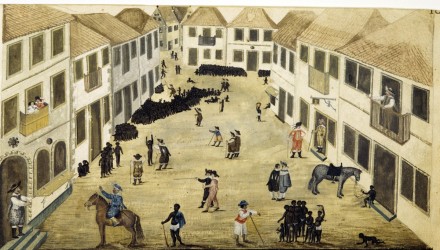
In 1642, the Portuguese Gaspar Dias de Ferreira (1595-1656) was a councillor and right-hand man to Johannes Maurits. * He and the governor conceived the plan to secretly equip a ship and use it to purchase enslaved people in Africa. These people would then be transported to Brazil outside the WIC monopoly and sold.
The Diemen secret slave ship
The decommissioned yacht Diemen was selected for the project. The WIC ship was sold to a so-called Portuguese company. It was subsequently converted and camouflaged to look like a Portuguese ship. A Portuguese crew and captain (Antonio Machado) were enlisted. The captain and crew were not really trusted. Therefore, a nephew of Ferreira and a dozen Dutch soldiers were sent along to safeguard the interests of the business partners. However, that was to no avail.
Seizure
Antonio Machado revealed the scam upon arrival at the island of Goeree, the WIC slave depot in Senegal. The illegal ship (the so-called 'lorredraaier') was promptly seized. After Gaspar Dias's nephew threw his weight into the fray as a relative of the Councillor of Brazil, the ship was eventually released on bail of six thousand cruzados. The scam could continue.
Evidence destroyed; The Diemen sunk
Upon arrival in Brazil, the ship anchored at Porto Calvo, disguised as a Portuguese ship after having passed Recife. The human cargo was secretly brought ashore, and the ship was destroyed and sunk.
Aftermath
Calado notes that the secret had not really remained secret. The High Council of Brazil was aware of the secret practices of Maurits and Dias; the members of the Council decided to keep it secret for the sake of the good name and reputation of the WIC and the governor. Johannes Maurits van Nassau-Siegen was not charged. His title, lineage, and family ties to Stadtholder Frederik Hendrik prevented that. But his days as governor of Bra
Description
References
- De Laet, Johannes (1644)
Historie ofte iaerlijck verhael van de verrichtinghen der geoctroyeerde West-Indische Compagnie. - NA, Den Haag, OWIC, 1.05.01.01, 57. 185
Lijst van schepen en jachten te Brazilië. [1639] - Carolina Monteiro, Erik Odegard (2020)
Slavery at the Court of the ‘Humanist Prince’ Reexamining Johan Maurits van Nassau-Siegen and his Role in Slavery, Slave Trade and Slave-smuggling in Dutch Brazil
Journal of Early American History