History
The Africaanse Galei was a frigate in the service of the Dutch East India Company (WIC). During research in the notarial archives in Amsterdam, an attestation (an official declaration in writing) about the final voyage and the loss of the Africaanse Galei was found. This ship made voyages from Europe via Africa to the West Indies and then back to Europe, so-called 'triangular trade'.
Triangular trade
The triangular trade had three stages. Trade goods from Europe and Asia were traded for enslaved people from Africa. These trade goods are called the trade cargo. The Africans were sold in South America. They were, rather disrespectfully, called the 'intermediate cargo'. Then trade goods from Africa and South America (gold, ivory, sugar, skins, tobacco, coffee, indigo and cotton) came to Europe to be sold there. This was the so-called return cargo. A triangular voyage took an average of 18 months. During the voyage, the ships crossed the Atlantic several times.
Voyage
The attestation also contains a copy of the ship's journal in which captain Thomas Zeeraad recorded the positions and events of the journey every few days. Based on this data, a map has been made that depicts the final voyage:
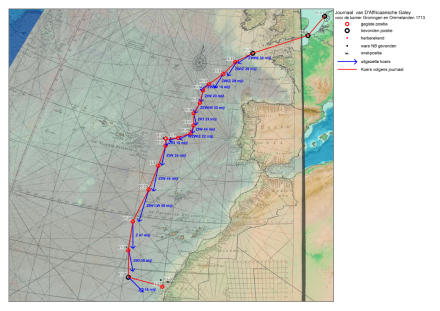
Have a detailed look at the map.

The ship was close to the coast of the Western Sahara on January 26th, 1713, when a hard wind (called travaat in old Dutch) began to blow. The topsails were taken down but it was already too late for the ship had hit shallow grounds. The strong waves pushed the ship ever more to the coast. An anchor was cast out, but to no avail. The bottom of the ship was struck to pieces and the bow of the ship came loose. The boat and the sloop were put overboard. A part of the crew made it to the beach. According to the archive piece, the wreck was 'the shot of a two pounder from the shore' (an old way to measure distances at sea, the distance that a two-pound cannon could shoot). The coast was uninhabited without trees or water. They went out with the sloop to look for help and encountered an English barquentine. They were helped by them in exchange for a part of the salvaged goods. When they left the scene of the accident, the ship had already been smashed to pieces.
Description
| Master | Thomas Zeeraad |
|---|
Status
The wreck was smashed to pieces soon after the accident.
References
- Stadsarchief Amsterdam, 5075
ref. no. 7362, pp 305 - driehoeksreizen
- Slave Voyages
Slave Voyages