History
Battle of Bergen
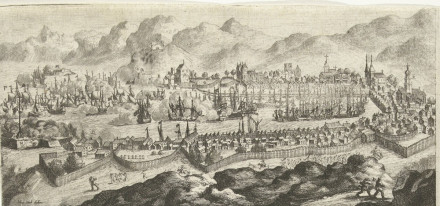
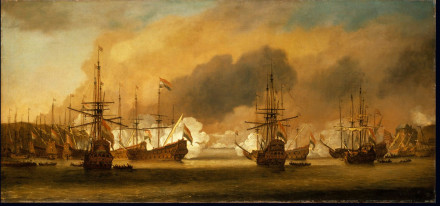
The Battle of Bergen (Norwegian: Vågen Bay) took place on 12 August 1665 in the harbor of Bergen between an English naval squadron and a Dutch merchant fleet consisting of about sixty ships, including the VOC (Dutch East India Company) return fleet from the East Indies of 1665 under the command of Pieter de Bitter.* The English squadron was commanded by Sir Thomas Teddeman.
Return Fleet of 1665
The VOC fleet had departed from Batavia on Christmas Day 1664, bound for the Netherlands. In early April 1665, they stopped at the Cape of Good Hope to resupply. There, they heard about the threat of war in Europe. England had declared war on the Dutch Republic.
War
On June 11th, 1665, the Dutch fleet suffered a major defeat at the Battle of Lowestoft. Admiral Obdam was killed, and his flagship Eendracht was blown up. The English dominated the seas. The Dutch fleet was badly damaged and unable to intercept the expected VOC fleet from the Indies.
The 'Backdoor Route'
De Bitter chose the 'backdoor route' (via the west of Ireland and north of Scotland to the North Sea) to avoid the dangerous English Channel. On August 1st, the VOC fleet arrived near the Shetland Islands. On August 1st, the VOC fleet arrived at the Shetland Islands. The weather was poor, and there was no escort fleet from the Netherlands. De Bitter then received a message from the Netherlands: he was to temporarily seek a neutral harbor to avoid the English and wait there until the war fleet was ready to escort him. On August 8th, De Bitter entered Bergen in Norway.
Meanwhile, the English had gotten wind of the arrival of the wealthy VOC fleet in the North Sea. A squadron was sent out to hunt the fleet from the Indies.
Rich Prize
At the same time, a diplomatic offensive was launched. The Danish king Frederick III - formally an ally of the Republic - was persuaded by the King of England to join a covert plan. The British navy would attack and capture the VOC fleet in Bergen. The Danes would loudly protest this violation of neutrality but would not intervene. The Danish king would then receive half of the rich spoils. However, the plan failed because the messenger carrying this instruction to the Danish governor of Bergen arrived too late.
On August 11th, the English squadron anchored outside the harbor of Bergen, trapping the Dutch ships inside. Thomas Teddeman went ashore to discuss the secret agreement with the Danish governor Cicignon and the commander of the Norwegian garrison, Klaus Ahlefeldt. However, they had not yet received any message from Copenhagen and therefore refused the English request.
Attack of the English squadron
Teddeman did not want to wait and decided to attack the next morning. He positioned his ships in a crescent formation. At the same time, De Bitter prepared for the impending attack and also arranged his strongest ships in a crescent formation. To reinforce the Norwegian fortifications, he had 30 cannons brought ashore along with 100 men to operate them.
On 12 August at 6 a.m., Teddeman began the battle. Volley after volley rang out. The Danish-Norwegian garrison initially remained neutral, but when the English fired on the fort and killed four Norwegians, they joined the fight.
This greatly aided the Dutch fleet. In addition, the offshore wind favored the Dutch ships. The English could not deploy fireships or sail further into the bay. Moreover, they had to contend with a smoke screen that obscured their vision. Eyewitness Wouter Schouten described it as: we smoked the saltpeter into their faces, so that many died gasping.**
After three and a half hours of fighting, the English retreated in disorder. On the British side, there were more than 500 dead and wounded; on the Dutch side, there were 25 dead and 75 wounded.
*The return fleet consisted of the following ships: Walcheren (admiral.), Phoenix (vice admiral), Slot Honingen, Rijzende Zon, Muskaatboom, Wapen van Hoorn, Bredero, Amstelland, Diemermeer and Ooievaar (see Schouten, p. 169).
**The battle is described in much detail by Wouter Schouten as an eye witness. He was the surgeon on the Rijzende Zon.
Description
The War Fleet under De Ruiter Arrives
On August 30th, Michiel de Ruiter arrived off Bergen. Remaining offshore, he gathered all the Dutch ships, and a week later the return voyage to the Netherlands began with the entire merchant fleet. They considered themselves invincible.
Then, on September 9th, a violent storm suddenly broke out. The fleet was scattered. De Ruyter tried for as long as possible to locate the straggling ships, but with limited success.
He therefore decided to set course for Texel with the forty ships he had managed to keep together, arriving there on 17 September.
The English, aided by the storm, still managed to attack and capture a considerable number of ships, including two richly loaded VOC return ships: the Phoenix and Slot Honingen.
References
- Wouter Schouten (1676)
Oost-Indische voyagie p. 169 e.v. - Dam, Pieter van
Beschrijvinge van de Oostindische Compagnie 1639-1701. I, 18,19