History
In the spring of 2018, during very low tide and persistent offshore winds, a section of a stern surfaced on the stony beach near the Oranjemolen in Vlissingen.
The wreck was known; it had previously surfaced during extremely low water in 2014 and 2007. At that time, the wreck was surveyed by the Walcheren Archaeological Service (WAD). In 2018, it was investigated and described for the second time by archaeologists from ADC-Archeo Projecten.
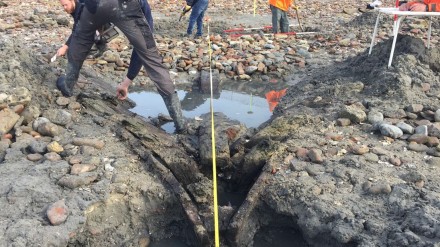
2018 Research
Three small pits were dug to allow inspection of the wreck. The wreck lay upright in the seabed. Remains of the stern, bottom, bilge timbers, and stringers were still present up to the bilge planks. Wood samples were taken from the wreck, which unfortunately did not yield reliable dating.
It concerns a two-masted coastal vessel from the late 18th or early 19th century. The ship is 22.5 meters long and up to seven meters wide. The oak of the frames did not yield enough annual rings for dating. The bow is still hidden in the rather steeply rising beach at the foot of the sixteenth-century Wall of Altena.
Walcheren Expedition 1809
A cannonball is still stuck in the wall of the historic Oranjemolen. This is one of the many that the English fired at the Oranjebolwerk in 1809 during the so-called 'Walcheren Expedition'.
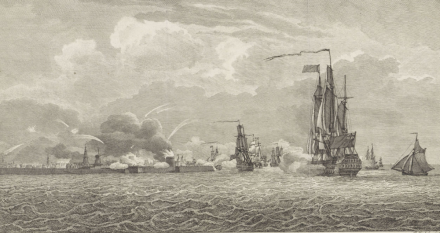
The bombardment of Vlissingen by the British in 1809
(printmaker: Reinier Vinkeles, after a drawing by Johannes Hermanus Koekkoek.
On July 30, 1809, a British invasion operation began in Zeeland during the war against Napoleon. An invasion force was transferred to Zeeland. Nearly 40,000 British soldiers landed on Walcheren to occupy the Western Scheldt and destroy the French fleet at Antwerp. During the fighting, Vlissingen was heavily bombarded by the English from land and the Western Scheldt. The wreck at Oranjemolen is believed to be connected to the action or its aftermath.