History
Boat from the early iron age
During excavations on the planned industrial area Vergulde Hand in Vlaardingen (the Netherlands) in 2006, a dugout canoe from the early iron age was found.
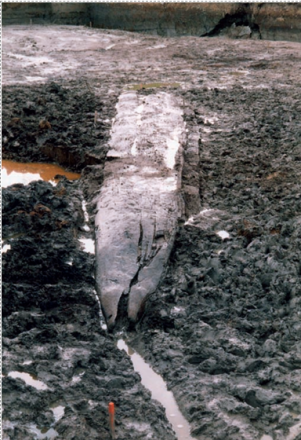
The dugout canoe is about 10 meters long. In the middle it is about 0.85 meters wide, but the boat has been much deformed. Because of this, the actual width could not be established. The canoe, that was lying upside down, was flattened by the soil on top of it and has been torn in several places, for instance near the bow and the stern.
Square holes and building traces
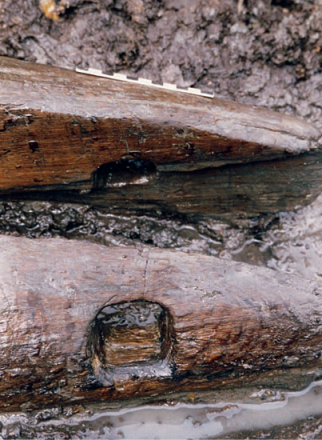
Because of the strong weathering on the outside, the heavy distortions of the bottom and the absence of fracture surfaces, it is unfortunately unclear if the canoe was rounded at the bottom or flat. A number of traces have been found on the canoe that tell something of how it was built and used. The bow contains square holes that may have been used to fasten a rope. Holes like this are more often found in dugout canoes. Traces of the wood having been worked with an adze were also found.
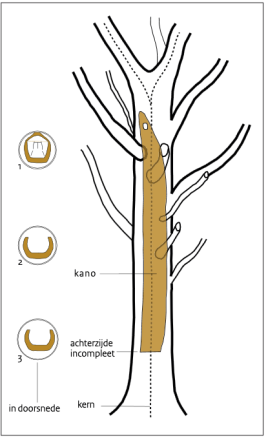
Based on the knots in the wood and its shape, a drawing has been made (not based on the actual shape) that shows how the canoe was possibly taken from the tree (RAM 200, p. 405).
Dating
The dugout canoe provided oak wood that could be dated with a (post quem) dat of 683 BCE (with a possible deviation of 6 years). A complicating factor is that the dugout canoe was not found in bog or clay of the early iron age, but in older layers of peat soil. So the canoe was not found in its original context, but n a secondary one, because of which the soil layer in which it was found, can not be used for dating.
Scouring
This is caused by the fact that the bog started floating and finally tore loose from its substrate (and in many cases from its complete surrounding) due to frequently recurring floods between ca. 250-200 BCE. Because of this, the water of the floods and all that it contained could end up underneath these layers. This phenomenon, causing younger material to end up in older levels due to flooding an rupturing, is called scouring. Of this dugout canoe it is also assumed that it ended up in the bog of the middle and late bronze age due to this phenomenon.
Description
Ribs
The inside of the canoe has a standing rim or rib at about 2 metres from the bow. In the back, at about 1 metre from the stern, there is another standing element that looks like the remnant of a rib. The function of this internal division is unclear. In literature, this type of divisions are interpreted as internal division elements; and possibly, when a rim like this is situated close to a sitting space, which is the case here in the back, as a foot support for the paddler. Their function as a reinforcing element of the canoe is doubted by several authors but requires more research.
References
- Y. Eijskoot, O. Brinkkemper en T. de Ridder (red.) (2011)
Vlaardingen. De Vergulde Hand-West
RAM 200