History
The Hōfuku Maru was a Japanese cargo ship converted into a prisoner-of-war ship (hell ship). On September 21, 1944, the ship was attacked and torpedoed by aircraft of the United States Navy.
Hōfuku Maru entered service after the end of the First World War and was used to repatriate German prisoners of war (POWs), many of whom had been held in Bandō prisoner-of-war camp. Most of the prisoners had been taken after the Siege of Tsingtao in 1914. After that she served in her intended role as a cargo ship.
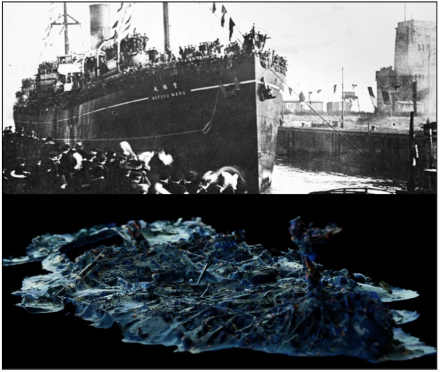
WW II Hell ship
In October 1941, Hofuku Maru was requisitioned by the Imperial Japanese Army for use as a troop transport. Allotted Army No. 524.. She would take prisoners of war to do forced labour in hellish conditions.
Last voyage
Hōfuku Maru was sailing from Singapore to Miri, Borneo, as part of convoy SHIMI-05. The convoy consisted of ten ships, five of which carried, in total, 5,000 POWs, all in poor conditions. At Borneo, Hōfuku Maru left the convoy with engine problems and sailed on to the Philippines, arriving on July 19. She remained at Manila until mid-September while the engines were repaired. The POWs remained on board, suffering from disease, hunger, and thirst.
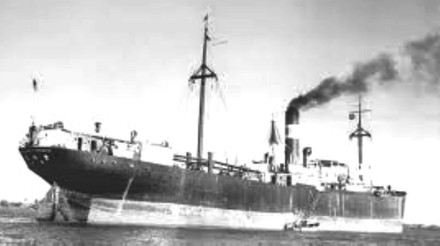
US Atttack
On September 20, 1944, Hōfuku Maru and ten other ships formed Convoy MATA-27 and sailed from Manila to Japan. The following morning, the convoy was attacked by about 40 carrier-based aircraft of Vice Admiral (later Admiral) Marc A. Mitscher’s (USNA’10) Task Force 38. All eleven ships in the convoy were sunk. The Hōfuku Maru was hit by 3 torpedoes and sank.
Casualties
Of those on Hōfuku Maru, 1,047 of the 1,289 British and Dutch POWs on board died. 242 POWs swam to shore, and 42 were rescued.
See for the Dutch casualties an d names Oorlogsgravenstichting
Description
Status
The discovery of the wreck of the Hōfuku Maru was made by explorer Josh Gates and researchers from the Hellships Memorial Foundation, working with underwater imaging specialists and maritime archaeologists. The wreck lies in more than 160 feet of water off Zambales province, a coastal region on the western side of Luzon.
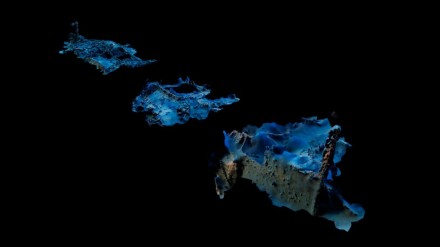
More than eight decades after it vanished in the chaos of World War II, the wreck of the Japanese prison transport Hōfuku Maru has been identified off the coast of Luzon in the Philippines, revealing one of the largest previously undiscovered resting places of Allied prisoners of war.
The discovery will be presented in the two-part season premiere of Expedition Unknown, titled Hunt for the Hellships, beginning Wednesday, June 24, 2026, at 9 p.m. ET/PT on the Discovery Channel.
References
- https://www.hellshipsmemorial.org
Historic Discovery: The Hellships Memorial Foundation Identifies the Wreck of Hōfuku Maru - combinedfleet.com