History
The screw-driven steamship SS *Snip* was a flotilla vessel built for service with the Government Navy in the Dutch East Indies. The *Snip* departed from Rotterdam in September 1899 and arrived in Surabaya on January 2, 1900. The vessel was deployed for administrative duties, transport, and hydrographic and cartographic work.
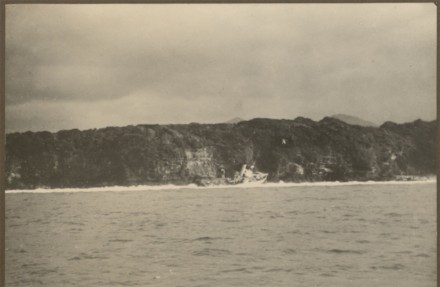
Hendrik Colijn took this photograph shortly after the Snip ran aground, shooting it from the Koetei—a vessel belonging to the same flotilla—which subsequently transported the shipwreck survivors back to Surabaya. The inscription reads: "*Snip* ran onto the rocks; final voyage in the Indies, 1909. South coast of Sumbawa."
Colijn’s inspection tour
In the late summer of 1909, the ship was on an inspection tour of the Lesser Sunda Islands. On board was Hendrik Colijn (who would later become Prime Minister of the Netherlands); at the time, serving as secretary to the Council of the Netherlands East Indies, he was undertaking an extensive official tour of the Outer Provinces to compile a report for the colonial administration.
Running aground
The *Snip* struck a submerged rock off the southwest coast of Sumbawa and became stranded. Heavy surf and the rocky seabed caused irreparable damage to the hull. An indigenous sailor swam ashore with a rope, thereby managing to save those on board. The ship was smashed to pieces against the rocks, and goods and personal belongings were lost.
Description
Built: P. Smit, Rotterdam, 1899
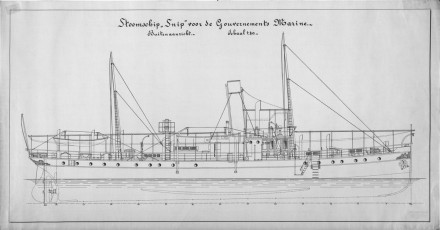
Government Marine
The *Snip* belonged to the Government Marine (*Gouvernements Marine* or GM). The GM was the state-run fleet of the colonial administration in the Dutch East Indies (the Indies Government), existing from 1861 to 1962. It primarily carried out civil-administrative, maritime, and policing duties within the East Indies archipelago—unlike the Royal Netherlands Navy and the Naval Force in the Dutch East Indies, which were responsible for military defense.
Function
Its role during the intensive colonial expeditions associated with the "Pacification Policy" around 1900 (under Governor-General Van Heutsz) was essentially logistical, exploratory, and supportive.
A key function of the *Snip* was hydrographic surveying. Around 1900, many bays, river estuaries, and stretches of coastline in the "Outer Islands" (territories outside Java and Madura) still required mapping:
Before or during military expeditions, the *Snip* would survey unknown coastlines, sandbanks, and channel entrances.
Using these soundings, the hydrographers on board mapped out navigable channels and suitable landing sites for heavier transport vessels and gunboats belonging to the Naval Force.
| Master | Hendrikssen, A. |
|---|
References
- De locomotief 11-9-1909
stranding Snip