History
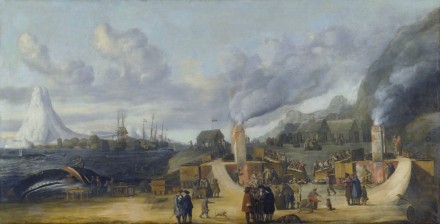
Smeerenburg is a former settlement of Dutch whalers of the Northern Company on the small island of Amsterdamøya (Amsterdam). Now a small uninhabited island, part of the Spitsbergen archipelago.
The settlement of Smeerenburg was founded on the island in 1619 by the Amsterdam chamber of the Northern Company; it would grow into the center of Dutch whaling off Spitsbergen.
Northern Company
The Northern Company was a Dutch trading company founded in 1614 to organize and monopolize whaling in the Arctic Ocean, particularly around Spitsbergen. The company consisted of various "chambers" (departments) attached to cities such as Amsterdam, Rotterdam, Hoorn, Middelburg, Enkhuizen, Delft, Veere, and the Zaan region. Each chamber had its own blubber rendering plants and facilities on Spitsbergen, where whales were processed into whale oil and other products.
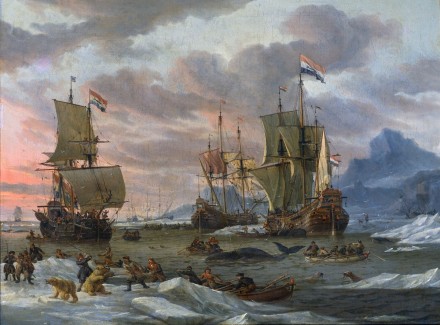
A number of whalers can be seen in this painting by Abraham Storck (SK A 4102)
Whalers
The ships used for whaling were often fluyts. These ships had a round, broad hull shape with a flat bottom, which made them stable in shallow water and suitable for carrying heavy cargo.
The round shapes of these ships had the additional advantage that the ship was pushed upwards when the ice clamped shut, rather than being crushed immediately.
To withstand the pressure of the ice in polar regions, the ships were extra reinforced with thick planks and sturdy frames. Additionally, they were equipped with a heavy beam across the ship, to which the harpooning sloops were attached. The beams also served to pull the enormous whales aboard.
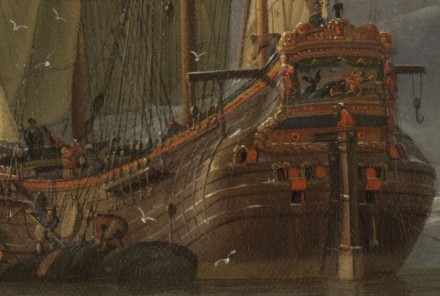
'De Jonas', alongside a whale being processed on the spot. The beams on the aft deck of the flute are typical of whaling vessels. The harpooning boats were attached to them. (detail of SK A 4102)
Whale oil
Whale oil was extremely valuable. The oil was not only used as a lubricant in, for example, rope factories and shipbuilding, but was also widely used as lamp oil and in soap production. A killed whale could fetch €20,000–€50,000 (in 17th-century value). The settlement consisted of about 20 houses and 7 blubber rendering plants and was inhabited only during the summer months. Attempts were made to overwinter, but these were often unsuccessful due to the extreme cold and lack of food.
End
The blubber rendering plants of Smeerenburg remained in operation until around 1660. Eventually, the hunters had to catch their prey at such a great distance from the Dutch settlements on Spitsbergen and Jan Mayen that it was faster to dissect the whale alongside the ship and transport the blubber home immediately to cook it.
Status
In Smeerenburg, extensive archaeological excavations were carried out in the 1970s and 1980s by Dutch archaeologists under the leadership of Louwrens Hacquebord of the Arctic Centre of the University of Groningen.
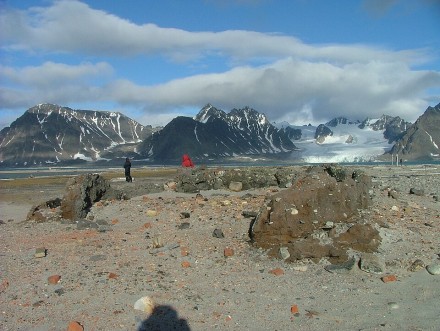
Remains of blubber rendering plants at Smeerenburg
During these campaigns, the remains of a settlement were inventoried, which served as a land station for the processing of captured whales between approximately 1614 and 1660. Numerous artifacts from the Dutch period were found, such as iron tools, semi-finished products, and forge materials, which were initially kept in the Netherlands and later partially transferred to Norway. Graves were also excavated, revealing unique finds such as wool and silk clothing and fully clothed skeletons, which had been excellently preserved by the permafrost. The excavations showed that Smeerenburg did not have thousands of inhabitants, as was sometimes assumed, but rather about twenty houses with room for a few hundred people.
References
- Louwrens Hacquebord
Smeerenburg het verblijf van Nederlandse walvisvaarders op de westkust van Spitsbergen in de zeventiende eeuw - anoniem (1684)
De seldsaame en noit gehoorde walvisvangst, voorgevallen by St. Anna-Land in't jaar 1682. den 7. October. Midsgaders een pertinente beschrijvinge, van de ge - Zaanwiki
Walvisvaart