History
On April 14, 1638, the newly promoted Admiral Cornelis Cornelisz Jol departed from Texel with a fleet of 10 ships bound for Dutch Brazil. On June 8, the admiral arrived at the roadstead of Pernambuco (Recife). He had special instructions from the WIC board of directors. He was to hunt for the silver fleet off Cuba.
Ten years had passed since Piet Hein’s successful capture of the Spanish silver fleet. In 1638, the Gentlemen XIX of the WIC believed that if anyone would be capable of equaling Piet Hein, it would be Cornelis Cornelisz Jol, nicknamed Houtebeen.
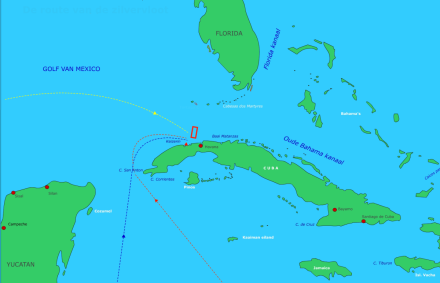
In Pernambuco, another four ships were added to his fleet. On June 22, the fleet departed for Cuba with 600 soldiers and 900 sailors on board. Meanwhile, Jol likely met his Vice-Admiral Roosendael at the rendezvous point Isla Vacha (Haiti), after which they sailed together to the operational area north of Havana. His fleet now consisted of 17 or 18 ships, including a number of privateer vessels (commission-ships) that had followed the fleet.
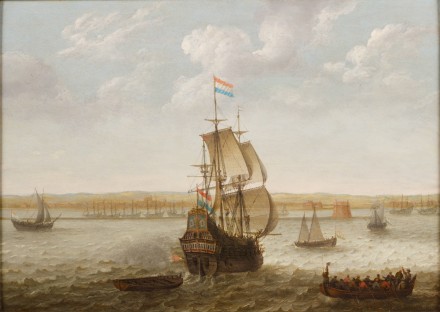
Spanish Fleet
Despite the secret preparations, the Spaniards were well aware of Jol’s intentions. Fast yachts were sent from Spain to Vera Cruz and Cartagena to warn of the arrival of the Dutch. The Flota de Nueva España remained anchored in Vera Cruz (Mexico).
The Flota de Tierra Firme (carrying the silver from the mines of Potosi and Peru), led by Admiral Don Carlos de Ibarra, did depart from Cartagena for Havana on August 8, intending to cross over to Spain from there. His fleet consisted of seven galleons, a royal yacht, and six merchant ships.
When De Ibarra arrived at the western tip of Cuba on August 23, he received the reassuring message from Havana that only seven enemy sails had been sighted. He did not consider seven Dutch privateers a serious threat to his fleet.
On August 30, he spotted the Dutch fleet off Cabañas, and the outcome was disappointing. The WIC fleet consisted of 17 sails. And there were more Dutch privateers (commissioned vessels) in the vicinity. The Ibarra was battling strong headwinds and making slow progress. An encounter seemed inevitable.
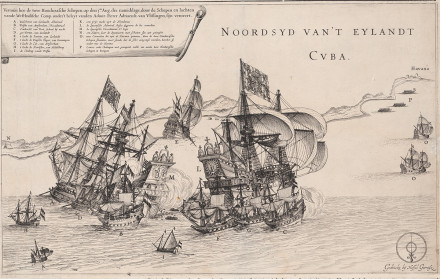
Pieter Adriaansz. Ita was a WIC admiral who managed to capture two ships of the Spanish Silver Fleet in 1628. The enormous difference in size between the Spanish galleons and the Dutch ships is clearly visible in the engraving. Ita's achievement was completely overshadowed by Piet Hein, who captured the rest of the Silver Fleet just a month later.
The Battle of the Admirals
Jol’s strategy was simple: supported by the Tertholen and Wapen van Rotterdam, he would attack, surround, and board the Spanish Almiranta San Mateo.
Vice-Admiral Roosendael and Rear-Admiral Jan Mast were to overpower their Spanish counterparts on the San Marcos and the Carmen, respectively.[1]
As agreed, Jol, with the Salamander supported by the yacht Tertholen and the Wapen van Rotterdam, steered toward the San Mateo with De Ibarra on board.
The Salamander's bowsprit became entangled in the rigging of the larger and, above all, taller San Mateo. Clinging on had been successful, but boarding was another story. The Spanish deck was full of Spanish defenders. Admiral Jol sent soldiers with hand grenades into the upper decks. Only from there could they cover the deck of the Spanish galleon. Once the Spanish defenders had been driven from the deck, the Dutch could proceed to board. At that moment, De Ter Tholen and Wapen van Rotterdam had already dropped back and lay idle, out of range, waiting.
Battle elsewhere
Elsewhere, things did not go according to plan either. Vice Admiral Roosendael on the Faam had indeed managed to come alongside the San Marcos and latch onto it. However, the San Marcos managed to break free again. Roosendael was killed during this battle. The now-free San Marcos was now heading toward the Salamander to help De Ibarra.
Jan Mast's action on the Hoop against the Carmen was also successfully repelled. This battle is vividly described by the captain of the Carmen, Urdanivia.[2] Rear Admiral Jan Mast was killed during this battle.
De Carmen and the San Mateo, freed from their attackers, headed toward De Ibarra and Jol. De Salamander was now in danger of being surrounded itself, even though the boarding attempt finally seemed successful. In the given situation, Jol had to cut the grappling hooks to avoid being overpowered himself. After two hours of fighting, Jol withdrew. Most captains had ignored their orders and did not join the battle.
Impasse
A stalemate arose. The Spaniards could not get past the Dutch fleet, and the Dutch had failed to capture even a single galleon. Out of range of fire, Jol signaled all captains to board his ship. The fallen flag officers were replaced. Houtebeen Jol was furious about the cowardly behavior of his captains. At a remark by the captain of Het Wapen van Rotterdam, Jol struck him with his admiral's staff. The captain was relieved of his duties on the spot.
Second attempt
After a fiery speech by the admiral in which he cited Piet Hein, honor, and fatherland, a second attempt was made. Jol was hopeful that things would go better. He believed that morale had now improved. Jol attacked with his remaining ships, but this time, too, matters did not go as planned. Orders were not followed again, and the admiral was accused of being too reckless. The Spanish ships were very large: no one listened to his orders.[3]
Twelve of his ships attacked the Carmen. The galleon was heavily damaged. The Ibarra towed the Carmen to Bahia Honda where 20 dead and 28 wounded were removed from the ship. The cargo was transferred and the ship was set on fire. The battle was stopped. The fleets separated but remained in the vicinity.
Third attempt
Meanwhile, a ship's council was held again on the Salamander to prepare for a new attempt. Jol believed he had restored order once more. On September 3, the attack was launched again. But the momentum had passed. The Spanish ships now had the advantage because they had a tailwind.
The Dutch had a headwind and had to tack to reach the Spanish ships, while the Spaniards were able to fire freely. During those bombardments, Captain Verdiest of the Oranje was also killed. Once again, the battle was halted prematurely. All three of Admiral Jol's attack attempts had failed.
Aftermath
On September 17, Jol received word that De Ibarra's fleet was still at Los Organos. The captains of the Zwolle, Overijsel, Goeree, Ernestus, and Mercurius were replaced by Jol for dereliction of duty, and he subsequently set course for Los Organos again. Upon arrival, he discovered that De Ibarra had sailed back to Vera Cruz in Mexico. On September 5, Ibarra set course for Veracruz. The fleet arrived in the harbor on September 24, 1638, where the treasure and merchandise were unloaded. Afterwards, great festivities were held in honor of the victory. Jol suffered a defeat; the silver fleet was not captured. Spanish sources report that 7 Dutch ships had sunk. Dutch sources do not mention losses.
Jol could do nothing more. He sailed back to the Republic. In the Netherlands, he initiated a lawsuit against the six captains who had ignored his orders. The captains were convicted in Holland but received relatively mild sentences. Ultimately, even Houtebeen Jol would never equal Piet Hein.
[1] Wright 1934 II. 45
[2] Goslinga 1971. 243, 244. Noordervliet-Jol 1994. 97. Wright 1921. 625
[3] Barlaeus
References
- S.P.L. Honore Naber, (1923)
Barlaeus Casparus, Nederlandsch Brazilië onder het bewind van Johan Maurits, grave van Nassau
’s Gravenhage - Goslinga, C. CH. (1971)
The Dutch in the Caribbean and on the wild coast 1580-1680. - Wright, I.A. (1934)
Nederlandsche zeevaarders op de eilanden in de Caraïbische zee en aan de kust van Columbia en Venezuela gedurende de jaren 1621-1648 (9).