History
Remains of a Roman bridge?
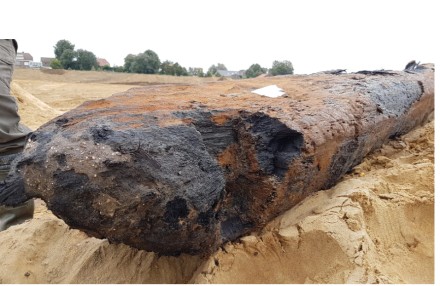
During sand extraction activities near Dreumel in Gelderland (the Netherlands), large oak poles were found near the hamlet of Moordhuizen.
They are likely pieces of wood from a Late Roman bridge at the confluence of the Meuse and Waal rivers, situated between the present-day Gelderland hamlet of Moordhuizen and the Brabant village of Lith.
Cause
In 2010, a sand extraction project began at Dreumel. Prior to this, an archaeological firm had surveyed the 275-hectare area to determine whether archaeological research was necessary. The outcome was that nothing was to be expected, so the sand extractor was allowed to proceed. It soon became apparent that the area was full of archaeologically valuable remains.
Own initiative
Enthusiastic locals, including archaeologist Nils Kerkhoven, contacted the sand extractor, who granted them permission to conduct excavations on the large site after all. They were also allowed to remove archaeological artifacts from the conveyor belt on the sand dredger. While the volunteers received ample assistance from the Kerkhoven archaeology network, the Cultural Heritage Agency of the Netherlands (RCE) and the Province of Gelderland initially adopted a formal stance: they did not feel responsible for the countless finds, ranging from mammoth bones to canoes and ships, and stated that the volunteers were acting illegally. Following an investigation in 2021, which established that all parties had made mistakes, the situation has improved.
Collaboration
Sinds then, the RCE and the province assisted with, among other things, the examination of the wooden poles. A wood specialist determined that the quality of the never-preserved wood had deteriorated significantly.
Roman bridge
Roman stone bridges from the fourth century are already known near Cuijk and Maastricht. Despite the tufa stones found at the Over de Maas project, Roman specialist Wouter Vos of Archeo Vos believes this involves a wooden bridge.
Archaeologist Nils Kerkhoven is certain. He works for the archaeological service of the Municipality of Utrecht but is involved in the find as a private individual. "But I like to be straightforward."
Ye Vos is still being cautious. He has placed the find in a broader context. "In theory, it could also be a jetty, a quay wall, or mooring posts." But he considers a bridge the most likely. "At Cuijk and Maastricht, the foundation poles are considerably shorter." Because of the length of the poles, Vos opts for a wooden pole-frame bridge, which could be built and dismantled in a short time. Julius Caesar describes the construction of such a bridge across the Rhine in 55 BCE in his book on the Gallic Wars, De Bello Gallico.
Moordhuizen bridge and road
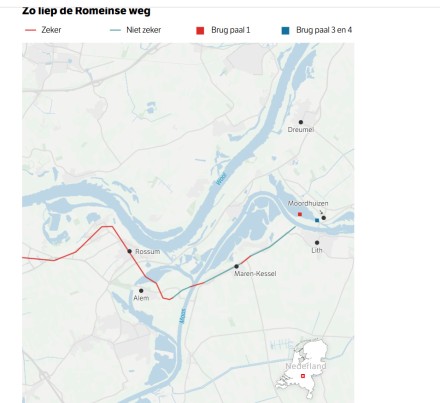
Vos understands that four poles, despite their physical characteristics, are insufficient to base a hypothesis on regarding the presence of a Late Roman bridge. "Much of the wood has likely been washed away or sucked away, but there are additional clues." He points out that the piles were found at the spot where the river belt was narrowest. “Furthermore, a piece of Roman road surface was found in the form of a mixture of gravel, rubble, mortar, and ceramic building material."
Broader context
According to Vos, the construction of the bridge is part of the investments that Roman emperors such as Julian (331-363) and Valentinian (364-375) made in the infrastructure of the ‘Rhine region,’ about which the fourth-century Roman historian Ammianus Marcellinus writes.
During that time, the rivers changed: less and less water flowed through the Rhine, and more through the Waal. So much so that, according to Vos, a land route from Nijmegen to the west became impassable at the confluence of the Meuse and Waal. “A diversion was necessary.” Therefore, according to Vos, a (temporary) bridge was constructed across the Meuse near Lith. Further along, possibly near Alem, the route was rerouted across the Meuse, to continue from there to the Helinium, the (then) wide mouth of the Meuse and Waal.
First find
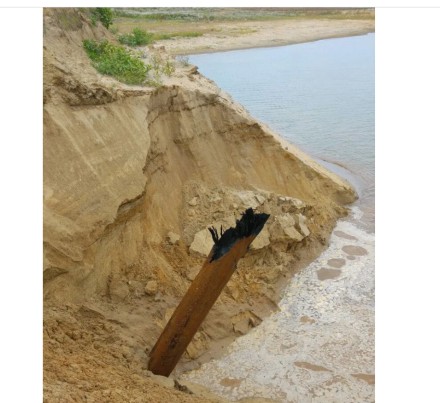
The first of a total of four Roman wooden poles was already found in 2018. This happened at a sand extraction site near the Meuse where it was partially sticking out above water. "It was not possible to get the pole out of the ground with a machine in once piece. We managed to get 11,50 meters out in four pieces - we were not able to take out the point, of which we could see the base. The pole, with a dimension of 30 x 40 centimeters, was estimated to have been over 13 meters long.
The huge pole was not immediately researched. It got a spot close to the site where it was found in a former cow stable, with countless other finds that Kerkhoven and the group of volunteers found in the sand extraction area of Over de Maas. Due to circumstances, lack of funds and problems with the RCE and the province, it remained there untouched for years.
Status
Dendrochronological research
The pole comes from the direct surroundings, the Elzas or the Eiffel. It was also clearly visible that the pole had been worked with a adze. Furthermore, a triangular mark and a notch could be seen. It is possible that this notch was used for a cross connection. And there were signs of woodworm in the pole, a sign that parts of the pole were sometimes over water.
At the RCE, dendrochronologists subsequently managed to date the wood. A relatively exact dating was possible, a felling date of 363 or 364 CE. This places the bridge in the same period as the bridge at Cuijk. There, where the poles of a Roman quay were removed in 2026.
The archaeological treasure trove of the Netherlands
The region around Kessel-Lith on the Brabant side of the Meuse and Dreumel-Moordhuizen on the Gelderland side of the Meuse is of enormous archaeological importance. It is here that the Waal and the Meuse rivers almost meet. In sand excavations near Lith and Kessel, very significant finds have previously been made by amateur archaeologists such as Leo Stolzenbach, like a Roman temple, remains of a Celtic sacrificial site, weapons and military artifacts, and a great deal of tufa stone. On the Gelderland side, several shipwrecks from the Roman period and the Middle Ages have been found.