History
Cog found during digging works
On March 31st, 2022, workers who were digging foundations near Tallinn’s old harbor, hit a wooden structure about 1.5 meters below the surface. The address was at at Lootsi Street 8, after which the find has been named. The work was stopped to perform archaeological surveying. What emerged from the wet sand was a surprise. It turned out to be the remains of a large 14th-century merchant ship.
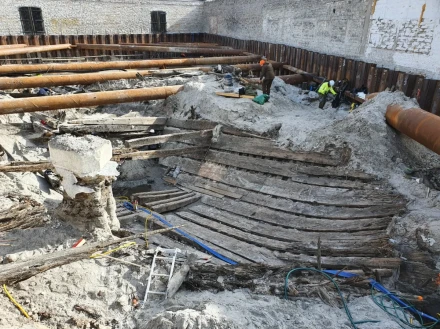
The ship, called the Lootsi 8 cog, is approximately 24.5 meters long and 8.6 meters wide. Researchers describe it as one of the best-preserved medieval ships found in Europe. It was so large and fragile that specialists had to lift it in four large sections and transport it to the Estonian Maritime Museum.
The site where the ship was found is now part of urban Tallinn. In the Middle Ages, however, the area lay on the shallow coast, near the former delta of the Härjapea River.
Dendro dating
Researchers analyzed 97 wood samples from the wreck, including hull planks, frames, beams, reinforcing planks and other structural elements. Of these, 87 were successfully dated through dendrochronology, the study of tree rings.
The results show that the main structure was built from oak trees felled in the winters of 1370–71 and 1371–72. Other parts, including planks from a possible galley or pantry-related structure, came from trees felled in winter 1373–74.
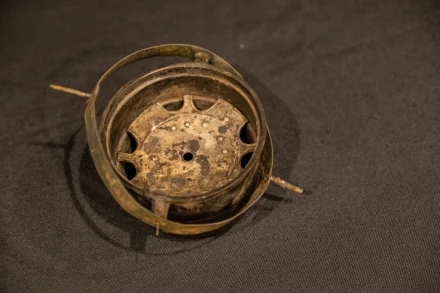
Dry compass from the wrecksite
Remarkable find
A remarkable find was a so-called 'dry compass' discovered in the wreck. A dry compass is a traditional magnetic compass in which the needle and compass rose rotate freely on a pin, without fluid damping. It is often enclosed in a box with a glass plate.
A dry compass from the 14th century is not an everyday find. The find of the compass on board testifies to the increasing importance of navigation instruments in medieval seafaring.
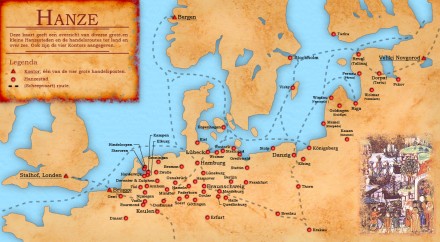
Hanseatic League
The 14th century was the period of the Hanseatic cities. Hanseatic cities are medieval cities (12th-16th centuries) that were part of the Hanseatic League, a trade alliance in Northern Europe. These cities collaborated to protect their trade, secure routes, and promote economic prosperity.
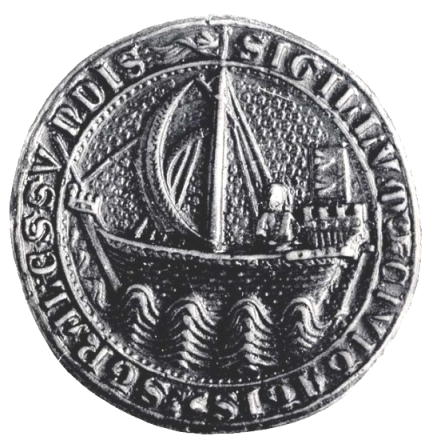
Cog
The cog was the workhorse during the period of the Hanseatic League. A cog was a robust cargo ship (used between the 12th and 15th centuries) with a flat bottom (carvel-built), a single mast, and a large square sail. The hull planks were clinker-built. They were fastened with long nails that were bent and hammered back for extra strength. The seams were sealed (caulked) with moss caulking and secured with so-called cinders (special nails).
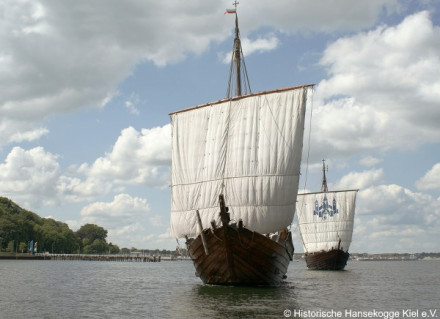
The cog was built to transport large amounts of bulk goods (with a cargo capacity of 10-60 tons) over sea and stood out because of its straight bow and stern.

In the Netherlands, around 15 ships have been excavated with typical cog traits. The finds were mainly done in the Flevopolder (the former Zuiderzee). Based on excavation data of the ZO 36, a replica of the Kampen Cog was built by the Stichting Kamper Kogge. A more recent find of a cog in the Netherlands was in the river IJssel near Kampen, the IJsselkogge.
Description
| Length | 80 ½ feet (24.5 m) |
|---|---|
| Width | 28 ¼ feet (8.6 m) |
References
- Arkeo news
One of Europe’s Best-Preserved Medieval Ships Was Found Beneath a City, With Its 600-Year-Old Compass - Vlierman, K. (2021)
COGGHEN, KLEENE COGGHEN ENDE SCHUTEN
SPA uitgevers, Zwolle