History
Part of Medieval Ship hull was hiding in a Cellar Ceiling in the Konradigasse in Konstanz am Bodensee for nearly 800 Years. What looked like a collection of old wooden boards in the ceiling of a cellar in southern Germany has turned out to be something far more unusual: the remains of an almost complete medieval ship hull.
Preliminary analysis suggests that the timbers belonged to a flat-bottomed sailing cargo vessel, broadly comparable with other medieval ships known from the Lake Constance area. Such vessels were suited to transporting goods across the lake, which formed an important commercial landscape connecting settlements in what are now Germany, Switzerland and Austria.
Reuse
it also records what happened after the vessel’s sailing life ended. Instead of being abandoned or destroyed, much of its hull was dismantled and transformed into part of a building
Description
The breakthrough came when archaeologists recognized features that belonged to a vessel: characteristic wooden fastenings, rows of nail holes and the distinctive shapes of the planks themselves.
Together, the surviving timbers cover more than 25 square meters of ceiling and include at least 19 planks. Parts of the hull appear to have remained together in their original relationship to one another when they were installed in the building.
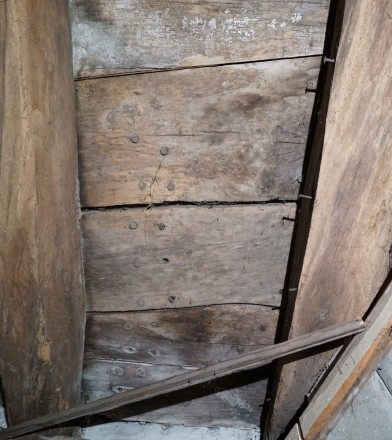
The cellar ceiling is made up of at least 19 heavy wooden planks, later identified as parts of a medieval ship hull. Credit: Landesamt für Denkmalpflege
Repaires
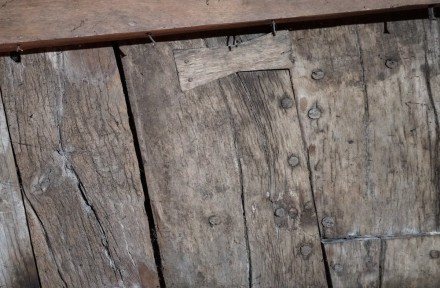
Archaeologists have already identified at least four repair areas where damaged sections of planking were removed and replaced with carefully fitted wooden inserts.
One repair is especially intriguing. It consists of a dovetail-shaped wooden insert, a technique for which researchers say there is currently no direct parallel in known medieval shipbuilding from the Lake Constance region.
Those repairs suggest that the vessel was maintained rather than simply discarded at the first sign of damage. The ceiling may therefore preserve evidence not only of how the ship was built, but also of how medieval craftsmen kept working vessels in service.
Caulking material
Even material once used to make the hull watertight has survived. Because several adjoining planks were installed in the ceiling while still fitted together as they had been aboard the ship, researchers found traces of caulking material between them. This sealing substance has now been sampled for analysis.
Status
Reusing the timber of an old ship was not itself unusual. Medieval builders often recovered valuable wood from structures and objects that had reached the end of their original working lives. What makes the Konstanz ceiling exceptional is the amount of the vessel that appears to have survived together.
Further research
The circumstances of the discovery also make it unusually valuable. Only a small number of medieval shipwrecks are known from Lake Constance, and surviving examples are normally submerged. Studying them requires underwater archaeological work and comes with considerable logistical limitations. The Konstanz timbers, by contrast, have survived for centuries inside a building and can be examined in a far more accessible environment.
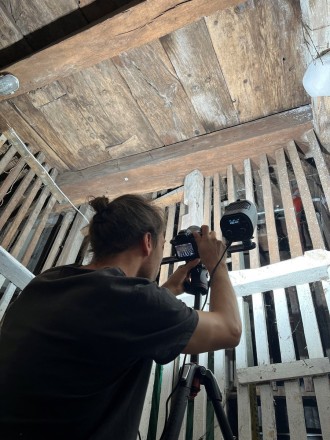
Researchers are now creating a detailed digital record of the hull. In mid-August 2026, the ceiling was documented using Structure-from-Motion photogrammetry, with hundreds of photographs taken from different angles and combined to produce a three-dimensional model.
Wood samples have also been collected for dendrochronological analysis, which may establish when the trees used to build the ship were felled. Those results could reveal whether the vessel was already old when its timbers were reused.
References
- Landesamt für Denkmalpflege Baden-Württemberg
Landesamt für Denkmalpflege untersucht mittelalterliches Schiff in einer Konstanzer Kellerdecke