History
The Kaapvogel was a jacht (a small, fast sailing vessel) belonging to the Dutch East India Company (VOC). Originally an English vessel named *The Merchant*, it was confiscated in Table Bay at the Cape by Governor van Riebeeck in July 1654. Initially, it was put into service for the newly established Cape Colony; however, the vessel proved ill-suited to the local weather conditions. On September 11, 1654, Van Riebeeck dispatched the Kaapvogel- along with the Goudsbloem, Haas, Boterbloem, and Angelier -to Batavia.
The Ambon War
Upon its arrival in the East Indies, the *Kaapvogel* was deployed to the Moluccas (as recorded in a naval register from February 1657). At that time, the region was highly volatile. Since 1650, the VOC had begun strictly monopolizing the production and trade of cloves. The Company mandated that cloves could only be cultivated in specific, controlled locations—a policy known as extirpation policy . "Illegal" cultivation and smuggling outside of these designated areas were met with harsh punishment, which in turn fueled uprisings and further smuggling.
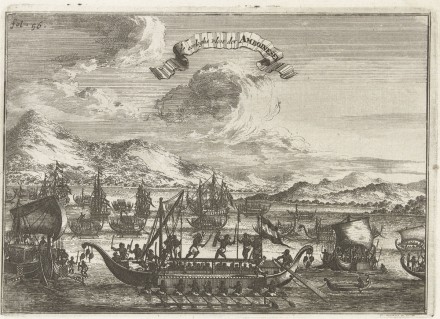
The heads of defeated enemies are depicted on the foremost kor-kora.
These are illustrations from Wouter Schouten’s *Reistogt naar en door Oost-Indië* (Voyage to and through the East Indies), published in 1676. In Chapter 7, he provides an eyewitness account of a *hongi* expedition that he experienced in 1659.
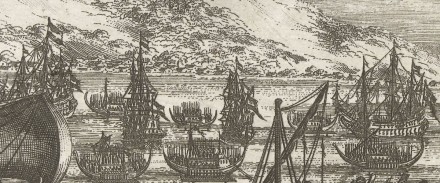
This detail from a depiction of a war fleet shows four VOC (Dutch East India Company) vessels—two ships, a *yacht* (a type of small, fast sailing vessel), and a *fluit*-like ship—amidst Ambonese *kora-kora* (traditional outrigger) craft.
The entire region became embroiled in war. Makassar and Tidore supported rebellious sultans who sought to circumvent the VOC’s monopoly. The VOC responded ruthlessly, burning down clove plantations and destroying sago groves to strike at the local population. After five years of conflict, the Moluccas were left largely devastated. The VOC had secured its monopoly in the region; Makassar and Spain were driven out of the archipelago, and Tidore and Ternate were placed under strict VOC supervision.
All of this took place shortly before the loss of the *Kaapvogel*. Although the primary focus of the conflict was Ambon, the east coast of the island of Halmahera remained a significant smuggling route for the illicit clove trade, with goods being transported to the Philippines and Makassar. In 1657, the *jacht* was deployed on patrol—part of the *hongi* expeditions—along the east coast of Halmahera. This territory fell under the jurisdiction of the Sultanate of Tidore.
The *Kaapvogel* ran aground in the Bay of Maba ("Moencko") and was broken apart by the surf. The crew and the cargo were successfully salvaged. A naval register of ships in the East Indies, dated January 1658, records the loss of the vessel: "the *jacht* *d' Caepvogel* lost at Moencko."
Description
Built: Amsterdam, ca. 1628
Owner: WIC kamer Amsterdam
Complement: 87 bemanning, 54 soldaten
Armament: 8 bronze,18 iron guns
| Tonnage | 60 ton (30 last) |
|---|
References
- navale macht in indie 15-1-1658
NA_1.04.02_1221_0196 - Gen. Missiven 17-12-1657. Deel III, 157
- Jan van Riebeek
Dagregister kaap