History
Ship used as a prison
The Hōfuku Maru was a Japanese cargo ship converted to transport prisoners of war. On September 21, 1944, the ship was attacked and torpedoed by aircraft of the United States Navy.
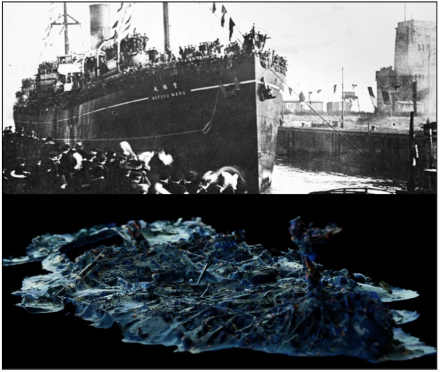
Initial use after WWI
The Hōfuku Maru entered service after the end of the First World War and was used to repatriate German prisoners of war (POWs), many of whom had been held in the Bandō POW camp. Most of the prisoners had been taken prisoner after the Siege of Tsingtao in 1914. After that she served her intended role as a cargo ship.
WW II 'hell ship'
In October 1941, Hōfuku Maru was requisitioned by the Imperial Japanese Army for use as a troop transport and was allotted Army No. 524. She would transport POWs to do forced labour in hellish conditions. For this reason, these ships were often called hell ships (also see Hell ship Junyo Maru).
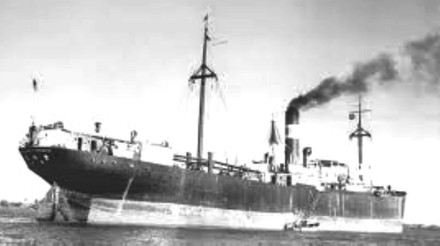
Final voyage
The Hōfuku Maru was sailing from Singapore to Miri, Borneo, as part of convoy SHIMI-05. The convoy consisted of ten ships, five of which carried, in total, 5,000 POWs, all in poor conditions.
At Borneo, the Hōfuku Maru left the convoy with engine problems and sailed on to the Philippines, arriving on July 19. She remained at Manila until mid-September while the engines were repaired. The POWs remained on board, suffering from disease, hunger, and thirst.
US Atttack
On September 20, 1944, the Hōfuku Maru and ten other ships formed convoy MATA-27 and sailed from Manila to Japan. The following morning, the convoy was attacked by about 40 carrier-based aircraft of Task Force 38 under vice admiral (later Admiral) Marc A. Mitscher’s (USNA’10). All ships in the convoy were sunk. The Hōfuku Maru was hit by 3 torpedoes and sank.
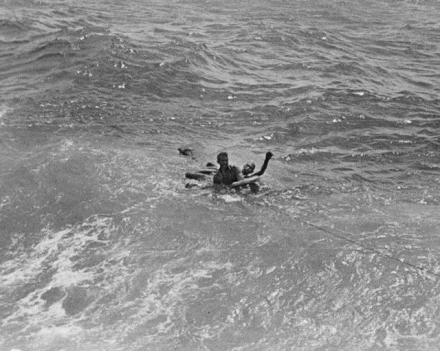
Casualties
Of the 1289 British and Dutch prisoners of war on board, only 42 survived. The majority, 1047, were locked in the hold and went down with the ship. The remaining 242 managed to escape and entered the water. But only 42 of them were rescued. The ship transported 250 Dutch POWs. For the Dutch casualties and names see Oorlogsgravenstichting.
Description
Type: Dai-ichi Taifuku-class cargo ship
Propulsion: triple expansion steam engine
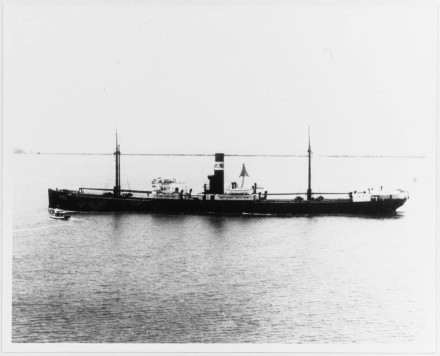
| Power | 436 hp |
|---|---|
| Speed | 10 knots ~ 12 mph (19 km/h) |
| Length | 385 feet (117.4 m) |
| Width | 51 feet (15.5 m) |
| Draft | 36 feet (11 m) |
| Tonnage | 5857 ton |
Status
Research
For many years, it has been known among the local population that a large shipwreck dating from the Second World War lies off the coast of the Philippine region of Zambales. Only recently has historical and archaeological research established that this is almost certainly the Hōfuku Maru. The wreck lies at a depth of more than 50 meters off the coast of the province of Zambales on the island of Luzon.
The research consisted of a combination of navigation analyses and archival, cartographic, and archaeological evidence. The research was conducted by the Hellships Memorial Foundation, with support from the Cultural Heritage Agency of the Netherlands (RCE).
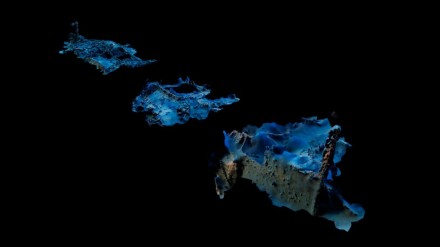
3D images of the site have also been made. The discoveries on the wreck have been incorporated in the Discovery Channel series Expedition Unknown, in the episode Hunt for the Hellships, that aired in June 2026.
War Grave
Those involved have been informed as far as possible via the (Dutch) Foundation for the Commemoration of Victims of Japanese Sea Transport (SHSJZ). On September 13, the foundation will draw attention to the discovery during the annual commemoration in Bronbeek. The wreck is considered a war grave, where the sanctity of the grave is respected out of reverence for the victims and their families. Therefore, the ship will not be excavated but left undisturbed.
The Netherlands maintains good contacts with all involved countries and is seeking, together with them, a suitable way to commemorate the victims. From the Netherlands, both the RCE (part of the Ministry of Education, Culture and Science) and the Ministries of Defense and Foreign Affairs are involved in this.
References
- https://www.hellshipsmemorial.org
Historic Discovery: The Hellships Memorial Foundation Identifies the Wreck of Hōfuku Maru - combinedfleet.com
- RCE (8-6-2026)
Japans vrachtschip, de Hofuku Maru, met Nederlandse krijgsgevangenen ontdekt - Wikipedia
Expedition Unknown