History
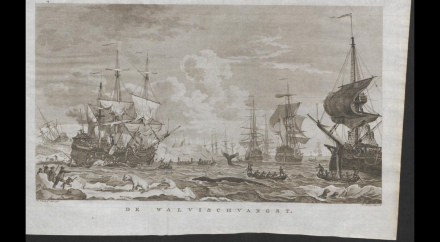
In the spring of 1777, a fleet of European whalers (including Dutch, English, German, and Danish ships) sailed—just like every year—to the Arctic waters around Greenland to hunt whales and seals.* However, the 1777 season would culminate in one of the greatest disasters in the history of whaling.
Trapped in the Ice
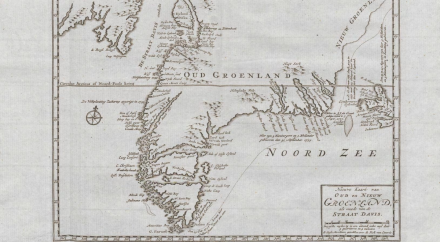
On June 24, more than 50 whalers were anchored at a large ice field east of Greenland, off the coast of Gael Hemkes Bay. They were waiting for whales to pass by. Due to fog, enormous masses of ice formed around them. Only the ships lying on the eastern side of the ice field managed to escape in time. 27 ships were left behind. Some of these ships succeeded in reaching open water again in August and especially in the first days of September, but 12-14 ships from Hamburg and the Netherlands were irrevocably trapped in the ice, which was being pushed inland by persistent easterly winds. Ships were crushed like matchboxes, and the men ended up on ice floes with almost no provisions or shelter.
Commandeur Hidde Dirks Kat van de Juffrouw Klara:
"Wij stonden hopeloos op het geweldig stootend ijs, in vreeze, om ieder oogenblik door hetzelve vermorzeld te worden. Het land was buiten ons gezigt. Wij waren nabij de opene zee en werden Zuid-westwaarts aan voortgeslingerd op de schotsen.." ¹
Surviving on Ice Floes
Most of the crew did manage to get off the ships alive. But without shelter and on ice floes drifting rapidly south due to wind and currents, hundreds of men died from drowning, hunger, freezing, and exhaustion. The last ship to be smashed was De Wisselvalligheid, commanded by Klaas Jansz Castricum, near Statenhoek, the southernmost point of Greenland, on October 11.
Commander Jeldert Jansz Groot of De Anna stated that of these 286 men, only 42 were still alive a few days later.²
About three groups of shipwrecked men managed to reach the Greenland mainland independently of one another after arduous journeys across the ice.
Rescue
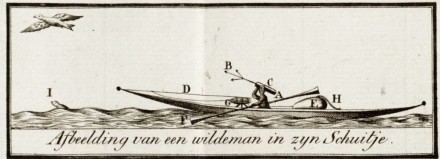
There they came into contact with the Inuit. The severely weakened men were rescued and, in some cases, brought to safety one by one on the back of kayaks and taken into their homes. Hidde Kat describes the Inuit houses in his diary.
The extra mouths soon proved to be too many, and hunger remained a major problem.
They could not stay in one location for long. The men were 'passed on' from settlement to settlement. Some spent the winter with the Inuit, others in the Danish colonies of Frederikshåb (now: Paamiut) and Juliana Hoop. In the course of 1778, the survivors were able to return home via Danish ships.
Literature
The disaster has been described in detail by various survivors and other writers (see references). Marten Jansen arrived in Amsterdam on May 31. Just a few days later, his story was on paper and published as: *Kort, doch echt-verhaal van commandeur Marten Jansen* (Short, yet true story of Commander Marten Jansen).
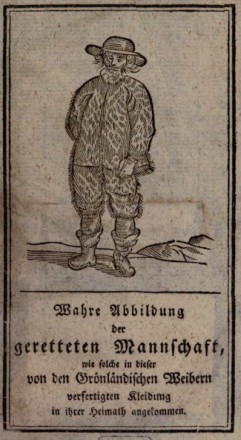
True image of a returning sailor from the 1777 disaster. He walked around Amsterdam in a seal costume sewn by Inuit women.
On July 12, 1778, a writer who remained anonymous saw three sailors walking through Amsterdam clad in Eskimo clothing. Suspecting that they were survivors of the Greenland shipwreck of the previous winter, he approached them. They turned out to be crew members of the Wilhelmina, which perished in the ice in 1777. The story of the three German informants is flowerily retold by the writer in: *Echt historisch verhaal op Wegens het verongelukken van hun Schip, de Wilmiena* (True Historical Story on the Disaster of Their Ship, the Wilmiena). A portion of the proceeds from this was intended for the destitute sailors.
It somewhat indicates how the events of that winter captured the public's imagination. Later, booklets about the disaster were published 17 times in various languages between 1778 and 1818. (Beelen)
*) The Dutch, German, and Danish languages reflect the international character of Arctic whaling, in which Dutch and Danish commanders could be in the service of German shipping companies, and German commanders could sail for Dutch shipowners; because many enlisting crew members came from the same region as the commanders (often one of the Wadden Islands). (Beelen)
Description
The commanders' ships* that were lost off Greenland
Hamburg ships.
Juffrouw Klara, Hidde Dirks Kat.
Sara & Cecilia, Hans Pieters
Zwei Hermanns, Engelbert Jensen, Romø
Mercurius, Hans Christiaan Jaspers
Jacobus, Pieter Andersen uit Romø
Het Witte Paard, Marten Jansen van Hamburg
Frau Agatha
Nederlandse ships
De Anna, Jeldert Jansz. Groot , Zaandam
D'Hoopende Visser, Amsterdam, Volkert Jansz
Wilhelmina, van Jacob Hendrik Broertje
De Wisselvalligheid, van Klaas Castricum
De Jonge Roggebloem, van Cl. Keuken de Jongen
De Vergulde Walvis, Roelof Meyer
De Vrouw Wyva Ida, Jacob Bremer
References
- Hidde Dirks Kat (1818)
Dagboek eener reize ter walvisch- en robbenvangst, gedaan in de jaren 1777 en 1778 door den kommandeur Hidde Dirks Kat, met eene kaart van Groenland - Marten Jansen (1778)
Kort, doch echt-verhaal van commandeur Marten Jansen
Nicolaas Byl, Amsterdam - Marten Jansen
Kort, doch echt-verhaal van commandeur Marten Jansen - C. Normann
En Rejse langs Grønlands Østkyst i Aaret 1777, - De Jong, D., Kobel, H., Salieth, M. (1792)
Nieuwe beschryving der walvisvangst en haringvisschery
pp IV. 409 e.v.
Jan Roos, Amsterdam