History
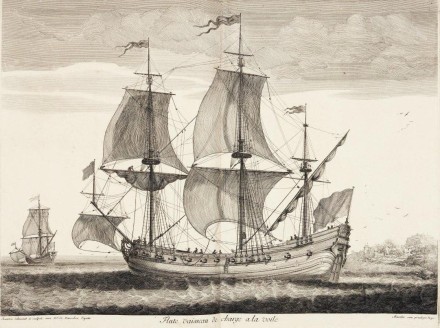
The Franse Europa ('Frnechwas originally a French warship. On July 9th, 1672, a number of ships of the French East India Company, amongst which the Europa, were captured by the Dutch East India Company (VOC) in the bay of Trincomalee in Sri Lanka. (See Dagregister 1672 under references).
Attack by French fleet
War had broken out in Europe. The Dutch Republic was being attacked from three sides by England, France, and the Bishop of Münster (the so-called Disaster Year 1672). In March 1672, a French fleet under Admiral de La Haye had attacked and occupied the VOC stronghold of Trincomalee. However, the French could not hold out for long; due to a lack of food and supplies, the French fleet departed again. A small garrison and four ships were left behind. Subsequently, this garrison had to surrender on July 9thth, 1672. In addition, four ships were captured: the Europa, St. Jean Baptist, Phoenix and Indian with 112 iron guns. The Europa was taken into use by the VOC under the name Franse Europa ('French Europe'), according to the VOC archives (see references).
Saint Helena
On January 17, 1673, the VOC return fleet of six ships departed from Batavia, bound for the Netherlands. Command was held by Abraham Huybertsen, skipper of Het Wapen van Ter Veer. The rest of the fleet consisted of the Alphen, Papenburg, Franse Europa, Pijnacker and the Stermeer (see Dagregister 1673 under references).
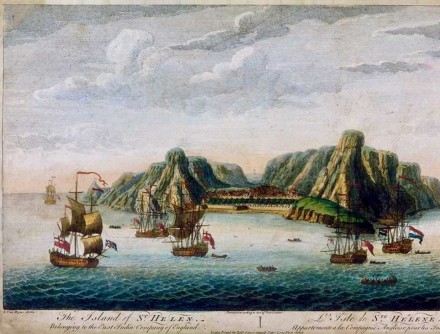
To strike the British, the Dutch fleet attacked wherever possible. For instance, a Dutch naval squadron led by Jacob de Gens had captured the English-held island of Saint Helena without significant resistance on January 1st, 1673). The English governor, Anthony Beale, fled to Brazil.
Return Fleet
On May 13th, a British naval squadron under commander Richard Munden arrived at Saint Helena. His mission was to bring supplies and reinforcements for the English garrison on the island. Furthermore, he had to intercept the English EIC return fleet and convoy it to England. Munden, in turn, managed to quickly recapture the island. The English heard from prisoners there that the VOC return fleet of 1673 was approaching.
The Franse Europa
Shortly thereafter, one VOC ship, the Franse Europa, indeed arrived at the roadstead of Saint Helena. The rest of the VOC fleet had sailed on. The Franse Europa had orders to call at Saint Helena first and follow later. In addition to supplies for the Dutch garrison on the island, the ship had the new governor Breitenbach on board. The Dutch flag was still flying over Fort St. James. The ship unsuspectingly anchored and was subsequently captured. Munden then set course for Ascension, where they were to pick up five English India Company ships. (see Kitching, p. 64).
Pursuit
On the way to Ascension, the Alpen and Het Wapen van Ter Veer were captured and taken to England as prizes. The Papenburg, Pijnacker, and Stermeer managed to escape. They took the so-called 'backdoor route' via the west coast of Ireland and the north coast of Scotland to the North Sea. This was common practice during wartime to avoid British ships in the English Channel.
Munden set off in pursuit. He was delayed by his prizes but had the advantage of being able to take the short route to the North Sea through the English Channel. Near Texel, he encountered the three remaining VOC return ships coming from the North. There, the Papenburg was captured. The Pijnacker and Stermeer managed to escape and arrived safely in the Netherlands. The fact that four of the six VOC ships had been captured represented a major setback for the VOC. Munden arrived in Portsmouth on August 20 with his captured VOC ships. He was knighted later that year for his actions at Saint Helena and the capture of such rich booty.
English service
The Europa entered English service under captain William Betts. While on a mission in the Mediterranean, she caught fire and sank. The fire was likely caused by negligence on board. Later, two sailors were executed for setting the ship on fire (see Threedecks.org under references).
Description
References
- DAS 5643.1
- Dagregister 4-10-1672
- Kitching, G.C. (1950)
The loss and recapture of St. Helena, 1673
The Mariner's Mirror
pp 58-68 - threedecks.org
Europa - HTR hub
VOC 1285 - Chijs, H.J. van der (1901)
Dagh-register ... Batavia, 1673