History
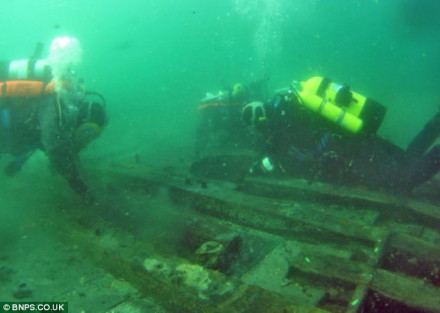
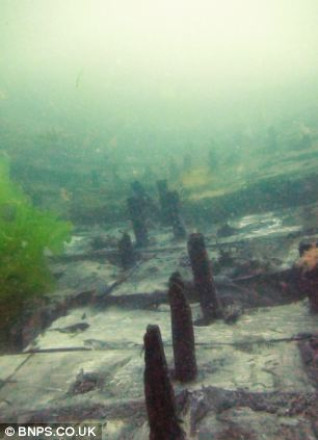
The so-called Swash Channel Wreck was discovered outside Poole Harbour in a sand and shingle bank that was struck by a dredger in 1990. In 2004, the site was first documented by Wessex Archaeology, during a geophysical survey in advance of dredging to deepen the approach to the harbour. Lying upside-down in approximately 6-9 metres of water with its longitudinal axis orientated north-east to south-west, this wreck from the early modern period was found to have survived in fantastic condition. An estimated 40% of the ship construction was found intact, prompting experts to hail the find as the most significant since the Mary Rose. English Heritage now administers the wreck and Bournemouth University are actively investigating the site.
Identification
Analysis of the annual rings of wooden materials from the site indicates a felling date of 1628 and points to an origin of the wood around the Dutch-German border. Based on this evidence, it is concluded that the ship is an armed Dutch merchant ship that sank in the 1630s.
Faam van Hoorn
Archival research in the UK has determined that the ship is called the Faam van Hoorn. A West Indies voyager that sailed from Texel to the West Indies in January 1631. The skipper was Jacob Jansz Bootemaecker. The ship was owned by two shipowners from Hoorn, Hercke Gerritsz and Cornelis Claesz Veen. The ship sought shelter from storms in Studland Bay. There, it was driven from its anchors and capsized.
Double hull
The ship was equipped with an outer hull of pine wood sealed with tar. This protective layer served to protect the hull itself from the pileworm, a harmful organism common in tropical waters that can seriously damage wooden ships. The double-hulled construction indicates that the ship was built for tropical conditions.

Description
Part of the hull washed ashore 2026
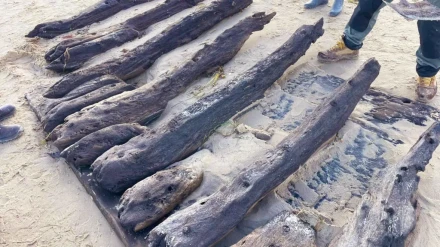
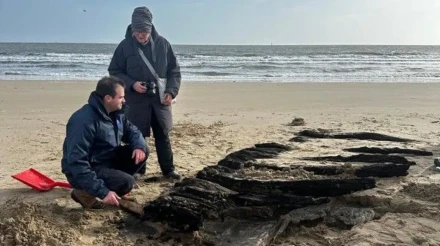
A section of a wooden shipwreck recently washed ashore on the beach at Studland Bay, Dorset. The fragment is being examined by Bournemouth University.
The ship's section, believed to be part of the hull, was discovered on the beach at Studland Bay after Storm Chandra on January 28, 2026.
The section consists of at least 15 timbers connected to five planks with wooden pegs. The fragment measures approximately 6 meters x 2 meters.
The structure suggests that the timbers had been buried in the sand since the 1630s and had surfaced only occasionally over the centuries.
Status
Partial recovery
The Swash Channel Wreck has survived in its excellent condition because it was soon buried by seabed sediments after it sank. However, when the wreck was revealed again by changes in the seabed after some 400 years, it not only attracted the attention of archaeologists but also that of wood-boring worms, and it became exposed to erosion processes. As a result, the Swash Channel Wreck has been rapidly disappearing ever since.
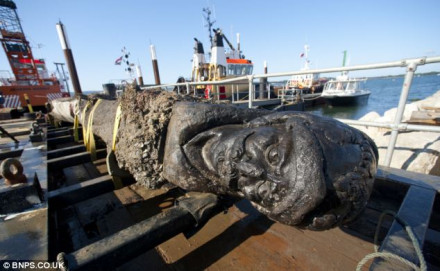
Despite stabilisation work on the wreck by archaeologists, which has included protecting it with various forms of coverings, it became clear that more drastic measures were necessary. With a Mary Rose-style recovery operation being prohibitively expensive, marine archaeologists from Bournemouth University led efforts to rescue parts of the ship deemed most at risk from degradation.
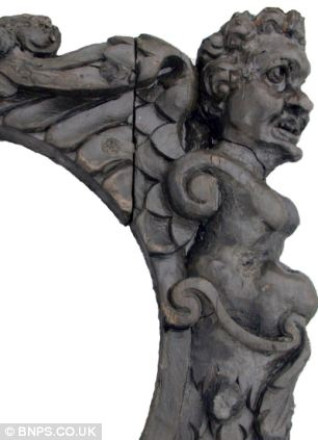
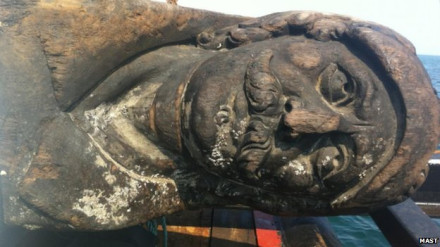
Thus in 2011, the forecastle, part of the upper structure of the ship, was raised and 12 metres of the bow followed the next year. The last major piece to be raised was the ship's spectacularly carved 2.5 ton rudder in 2013. Smaller artefacts brought up to the surface included more baroque carvings found on parts of the ship including the gunports, ceramic pieces, leather shoes, copper and pewter plates and cups and a bronze compass divider. Animal bones of sheep and cows that would have fed the crew were also recovered.
Status
Bournemouth University has analysed the finds and wreck parts. The part of the wreck that remains on the seabed is now covered in sediment and thereby preserved for future generations, thanks to the efforts of the archaeologists. It is one of the 46 sites in the English area of the UK Territorial Sea designated under The Protection of Wrecks Act 1973.
References
- Palma, P., D. Parham (2006)
Swash Channel Wreck; 2006 season report
Centre for Marine and Coastal Archaeology - Wooden carving of moustachioed warrior uncovered as wreckage of 400-year-old ship is pulled from the English Channel.
- Wessex Archaeology
Swash Channel Wreck - Wessex Museums
Swash Channel Wreck rudder