History
In the bay of Cahuita (Costa Rica) lie two shipwrecks that have been known for a long time. In the local traditions there has always been talk about two pirate ships. After archaeological research (Harris and Richards 2018.) it was suspected that they were not pirate ships but two Danish slave ships; the Christian V and the Frederik IV that disappeared in 1710.
In 2023, the wrecks were therefore investigated again by Danish maritime archaeologists. Analysis of wood samples, clay pipes and specific yellow bricks has yielded a Danish origin and a dating around 1700. This has almost definitively established that these are the two Danish slave ships.

The frigate Christian V was a slave ship in the service of the Danish West India Company (Vestindisk-guineisk Kompagni). She left Copenhagen in December 1708 together with the Frederik IV for a voyage to West Africa to buy enslaved people and then sell them on the Danish Caribbean island of Saint Thomas.

Slave coast
The first leg led to the Danish fort Christiansborg on the so-called slave coast in Ghana. The ships arrived there in March 1709. There, gold, ivory and enslaved people had to be loaded. Gold and ivory were in stock but enslaved prisoners were scarce. In such cases, it became a search along various slave depots along the West African coast to obtain the human merchandise.
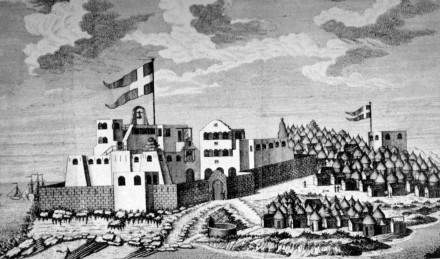
After months, the Christian V, with c. 450 enslaved people on board and the Frederik IV with 435 enslaved people were finally ready to depart (in October 1709) for the long voyage across the Atlantic. In the mean time, a revolt by the enslaved people on board the Frederik IV had been suppressed and skipper Maas of the Christian V had died when a boat turned over. There were hardly enough food supplies on board for the crossing. In January 1710, the two ships reached the Caribbean Sea but missed the supply station Barbados.
West Indies
Sources have been found in the Danish archives which seem to indicate that the two captains conspired to deliver the slaves not to Saint Thomas but to the Spanish Portobelo from the beginning. Higher prices could be asked there.
The ships indeed came to anchor 300 miles past Saint Thomas at an old pirate nest, the islet of Santa Catalina. They decided there that they could not return because of the total lack of food. The skippers decided to sail on to Portobelo to refresh there and sell the slaves. At that time there were still 671 enslaved people alive.
End
It didn't get that far. On the way they had to anchor again in a bay (Punta Cahuita) in the south of Costa Rica. There, the crew absolutely did not want to continue. They forced the officers to release the prisoners to save food and the money chests were plundered. The Frederik IV was set on fire. The Christian V did not fare much better. The anchor rope was cut, causing the ship to run aground and sink in the surf.
Part of the crew returned to Denmark via Portobelo. The enslaved people escaped largely into the forests and merged with the local population.

Description
Yard: in Larvik (DK)
Armament: 24
Crew : ca. 60
Owner: Vestindisk-guineisk Kompagni
| Length | 118 Amsterdam feet (33.4 m) |
|---|---|
| Width | 26 Amsterdam feet (7.4 m) |
Status
Research
The earliest archaeological exploration dates back to 1981 (by Gluckman). 30 years later, a team from East Carolina University (US) conducted research between 2015 and 2019. The site was mapped and finds described (Harris and Richards 2018).
In 2023, the two wrecks were again investigated by archaeologists from the National Danish Museum and the Viking Ship Museum. Analysis of wood samples, clay pipes and specific yellow bricks has revealed a Danish origin and a dating around 1700.
"The analyses are very convincing and we no longer doubt that these are the wrecks of the two Danish slave ships," said David Gregory, maritime archaeologist and head of the maritime research center Njord at the National Museum of Denmark. He emphasized the charred and sooty wood, which fits perfectly with historical accounts of a burning ship.
Slave Voyages
According to Slavevoyages.org, the Christian V made a number of voyages with enslaved people on board.
1699: Gold Coast to Saint Thomas. Of the 521 people taken on board, 353 survived the voyage.
1704: Bight of Benin to Danish West Indies. Of the 349 people taken on board, 295 survived the voyage.
1707: Christiansborg to Saint Thomas. Of the 447 people taken on board, 393 survived the voyage.
1710: Wydah to Spanish Caribbean. Of the 373 people taken on board, 318 survived the voyage.
References
- Harris,L, Richards, N. (2018)
Preliminary Investigations of Two Shipwreck Sites in Cahuita National Park, Costa Rica
International Journal of Nautical Archaeology - Trans-Atlantic Slave Trade - Database
- arkeonews
Centuries-old-shipwrecks-in-costa-rica-identified-as-danish-slave-ships