History
A wooden wreck, found over a century ago
In the Frisian village of Britsum, a wooden shipwreck was found in 1905. During the digging of a canal near the village, intended to transport the soil that was dug from the terp (an artificially constructed dwelling mound, common in this area in the middle ages) of Britsum in 1905, the remains of a ship were probably hit. Unfortunately, it was not conserved.
P.C.J.A. Boeles, then the curator of the Fries Museum, writes about the find a year later when he visited the dig site. It was a find "that could have possibly been of great importance, when the diggers had timely informed the Fries Museum."
Boeles mentions that the boat was roughly the size of a Frisian praam (a type of barge), "more or less related to the world famous find in the Nijdammerveen in Schleswig-Holstein," and that it most certainly was no dugout canoe.
Wood from a well
In 1906, Boeles was only able to save a few pieces of wood and these were entered into the so-called terpenboeken, the register of the Fries Museum in which all finds of excavations were recorded. The ship's wood received the numbers 20B: 231, 232, 240 and 241, under the number of the terp of Britseum.
Later (after 1906), Boeles added text in the margin next to the descriptions: "It later became clear when it was dug out that this wood belonged to a well and not to a ship." With this, he assumed that it had not been a ship after all.
Or ship's wood?
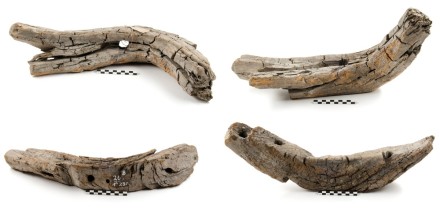
Three of the pieces of wood have been preserved and at present are kept in the climatised space of the Northern Archaeological Depot in Nuis. At least two pieces of this, both with no. 231, are actually pieces of ship's wood. The wood with no. 230 was also found back by researchers from the University of Groningen University (RUG). It is a board with pen holes and it also appears to be from a ship.
Dating
A piece of the wood with the label 231 was dated at the Centre for Isotope Research of the RUG. the C14 dating gave as a result that the wood dates from 685-778 CE.
The researched pieces are parts of two naturally bent oak wood frames (ribs). The knee has one round pen hole. These pen holes used to contain a wooden pen that connected the frames to the hull of the ship.
Description
Ship type
It concerns a boat made out of boards from the early middle ages and not a dugout canoe. The ribs are from a vessel with a flat bottom, like a punter (a narrow boat type) or an aak (a type of barge).
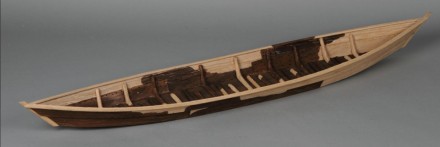
The fact that frame 2 was connected to the bottom of the boat with a rather narrow part, could indicate that it concerns a punter. As opposed to an aak, the bottom of a punter is pointed towards the bow and stern. The shape of the knee indicates that the vessel had an angular bilge.
Status
The discovery of a ship or ship's wood from the early middle ages in Britsum is important for maritime archaeology and for the archaeology of terps. It is one of the very few finds of ship's wood in the maritime terp landscape of the north of the Netherlands. Boeles assumed that it concerned a complete ship, of which a part was left in the ground undamaged.
"Maybe it turns out to be worth while to start an investigation into the still present part of the Britsum ship" he wrote in 1906
Further research
The authors of the article in Paleo-Aktueel that we are following here support this reasoning of Boelens from 1906. In view of the importance of this find, it is recommended to do further research on site. A preliminary investigation would be needed first, for instance by drilling, to see if there is indeed wood or a ship under the soil. The location can be estimated from the description of Boele (Nieuwhof & van Holk , p. 57).
References
- Annet Nieuwhof & André van Holk (2018)
Een vondst van groot belang: de boot van Britsum
Paleo-Aktueel 29 - Brouwers, W. , Jansma, E. Manders, M.
Middeleeuwse scheepsresten in Nederland, de vroege middeleeuwen 500-1050