History
The Alphen was a flute in the service of the Dutch East India Company (VOC).
She began her first outward voyage from Texel to Batavia on April 16th, 1663, for the VOC chamber of Amsterdam. Subsequently, the ship remained in Asia until October 1667 before returning to the Netherlands on May 18, 1668.
On December 14th, 1668, the ship departed for Batavia again, now for the chamber of Zeeland. Once again, the ship remained in Asia for a few years.
War
On January 17th, 1673, the return fleet departed from Batavia bound for the Netherlands, under the command of Captain Abraham Huybertsz, Skipper on the Wapen van Ter Veere. Asides from this, the fleet consisted of another five flutes, the Alphen, Papenburg, Franse Europa, Pijnacker, and the Stermeer (according to the Day Registers of Batavia, 15-01-1673).
At that moment, the Third Anglo-Dutch War was in full swing. To strike the British, the Dutch fleet attacked wherever possible. Thus, a Dutch naval squadron led by General Jacob de Gens had attacked Saint Helena. The English defenses were weak. The Dutch captured the island on January 1st, 1673, without much resistance. The English governor Anthony Beale fled to Brazil.
On may 13th, a British squadron under commander Richard Munden arrived at St. Helena. His mission was to bring provisions and reinforcement for the English garrison on St. Helena. Furthermore, he had to intercept the EIC fleet and escort them to England. In turn, Munden managed to swiftly retake the island. There he heard from the Dutch prisoners that the VOC return fleet of 1673 was approaching.
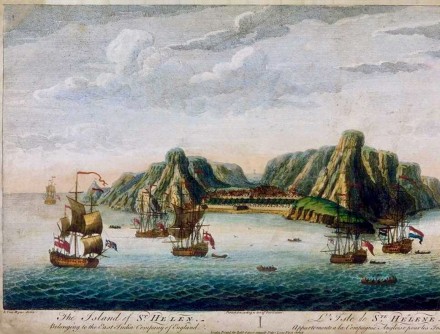
Shortly after this, one VOC ship, the Franse Europa, arrived on the roads of St. Helena. The Dutch colours were still flying above the St. James fort, so the unsuspecting ship anchored there and was taken. After this, Munden set sail towards Ascension where he was to pick up the EIC ships.
Chase
On their way to Ascension, the British chased the VOC squadron and the Alphen and the Wapen van ter Veer were also taken as prizes. The Papenburg, Pijnacker and Stermeer managed to escape. Later the Papenburg was also captured by Munden.
Munden arrived in Portsmouth on August 20th with his captured VOC ships. He was knighted later that year for his action at St. Helena and the capturing of such a rich loot.
Description
| Skipper | Jan Kop |
|---|
References
- Kitching, G.C.
The loss and recapture of St. Helena, 1673